
Low Testosterone
Natural Testosterone Boosters vs. TRT: What Works, What Doesn’t, and When You Need the Real Thing
Natural testosterone boosters vs TRT: which supplements have real evidence, which are worthless, and when your T is too low for any supplement to fix.
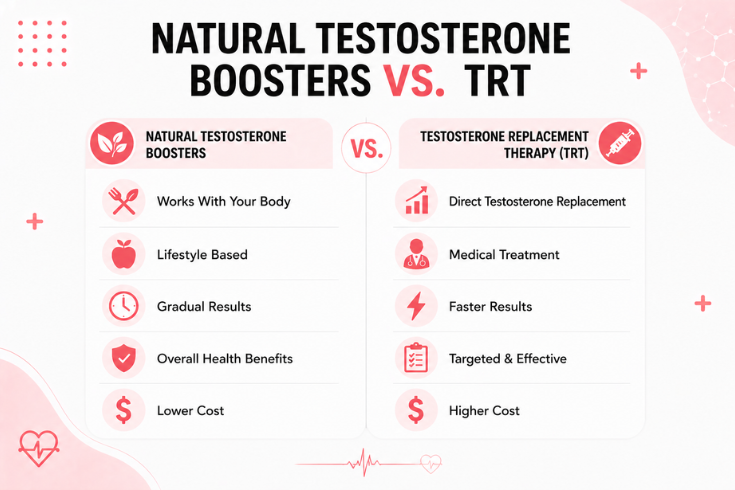
If your testosterone is clinically low below 300 ng/dL with confirmed symptoms — no supplement sold over the counter can fix it. That is not a philosophical stance against natural approaches. It is a physiological fact that follows from how each option works. Natural testosterone boosters and TRT are not two points on the same spectrum. They operate through different mechanisms, have different evidence bases, and are appropriate for different clinical situations. The comparison between natural testosterone boosters vs TRT only produces a useful answer once you understand what kind of problem you’re actually trying to solve.
Natural testosterone boosters are supplements — vitamins, minerals, or plant extracts — that attempt to stimulate the body’s own testosterone production through the hypothalamic-pituitary-gonadal (HPG) axis. TRT is a prescription .medical treatment that delivers testosterone directly, bypassing that system entirely. For this distinction to matter, you need to know which system applies to your situation. This guide covers what the evidence actually shows about each option — including which supplements have real clinical data, which are marketing noise, and when a third option (clomiphene) is clinically appropriate for men who need more than supplements but have reasons to avoid TRT.
Quick Comparison: Natural Testosterone Boosters vs. TRT
| Factor | Natural Testosterone Boosters | TRT |
|---|---|---|
| Mechanism | Stimulates body’s own production | Directly replaces testosterone |
| Works for clinical deficiency (T < 300 ng/dL)? | No | Yes |
| Works for optimization / borderline levels? | Possibly (ingredient-specific) | Yes, but carries overtreatment risk |
| Time to noticeable results | 4–12 weeks | 3–6 weeks |
| Fertility impact | None | Suppresses sperm production |
| Requires a prescription? | No | Yes |
| FDA regulated? | No | Yes |
| Approximate monthly cost | $20–$80 | $50–$500 |
| Evidence quality | Weak to moderate (varies by ingredient) | Strong for confirmed hypogonadism |
| Best suited for | Nutrient deficiency, mild symptoms, performance optimization | Diagnosed hypogonadism with symptoms |
The rest of this article explains the reasoning behind every row in that table.
What Natural Testosterone Boosters Can and Cannot Do
Natural testosterone boosters can work within strict limits. Whether they work for you depends on one factor: whether your testosterone production system is intact and underperforming, or whether it has a structural deficit that supplements cannot address.
A man whose testosterone is suppressed by chronic stress, vitamin D deficiency, poor sleep, or obesity may see real improvement from targeted interventions. A man with primary hypogonadism (damaged testes) or testosterone below 200 ng/dL will not — because the system that supplements are trying to stimulate isn’t functioning. The mistake most men make is treating all testosterone supplements as equivalent. They are not. Grouping them by evidence quality reveals three distinct categories.
Tier 1 Deficiency Correction: May Actually Help
These are nutrients the body requires to produce testosterone normally. Supplementing them can restore testosterone toward your baseline if you are deficient. They do nothing for men whose levels are already normal.
Vitamin D
Men with vitamin D deficiency have measurably lower testosterone. Studies show that restoring vitamin D to normal levels is associated with testosterone improvement in deficient men. In men who are not vitamin D deficient, supplementation produces no testosterone benefit.
Zinc
Zinc is required for LH receptor function and testosterone synthesis. Deficiency suppresses production; correction restores it. The pattern is identical to vitamin D: deficiency correction, not enhancement above baseline. Before concluding you have hypogonadism, test for both. Vitamin D and zinc deficiencies are common and correctable with inexpensive supplements — checking them first can save you from an unnecessary TRT evaluation.
Tier 2 Modest Clinical Evidence: May Help in Specific Contexts
These supplements have randomized controlled trial data showing real testosterone increases. The effect sizes are limited but documented.
Ashwagandha (KSM-66 extract)
Multiple RCTs show testosterone increases of 10–22% at doses of 300–600 mg daily. The proposed mechanism is cortisol reduction — ashwagandha is an adaptogen that blunts the stress response, and elevated cortisol suppresses testosterone. Men under chronic physiological or psychological stress tend to see the most benefit.
Fenugreek
RCT data shows approximately 12% increases in total testosterone. One 12-week trial in 50 healthy men found free testosterone rising from 8.2 to 12.0 pg/mL at 500 mg daily — a meaningful increase in the free fraction, which is the biologically active portion.
Tongkat Ali (Eurycoma longifolia)
Small RCTs in stressed or sleep-deprived men show modest testosterone increases, possibly through reducing sex hormone-binding globulin (SHBG) — which frees more testosterone for actual biological use.
These are real effects, not fabricated ones. But the numbers define their limits: moving from 380 ng/dL to 420 ng/dL through a 10% ashwagandha effect is meaningful optimization for a man in the normal range. It is not meaningful treatment for a man at 220 ng/dL.
Tier 3 No Credible Evidence: Marketing Only
Most commercially sold testosterone supplements fall here. A 2019 analysis of 50 products published in the World Journal of Men’s Health found that 90% marketed themselves as testosterone boosters, yet only 24.8% had any published data supporting their claims. Another 10.1% contained ingredients with data showing they decrease testosterone. More concerning: 13 of the 50 products exceeded FDA upper tolerable limits for zinc, vitamin B6, vitamin B3, or magnesium — creating genuine toxicity risk, not just ineffectiveness.
Specific offenders with no trial support:
- Tribulus terrestris: Failed to raise testosterone in controlled trials despite decades of marketing as a T-booster.
- DHEA: Converts to estrogen as readily as testosterone. Outcomes are unpredictable, and estrogen-dominant results are common in some men.
- Most proprietary “testosterone support” blends: Typically combine underdosed Tier 2 ingredients with Tier 3 fillers, wrapped in enough marketing language to justify a $60 price tag.
What TRT Actually Does
TRT is not optimization it is replacement therapy for a medical condition. When the body produces insufficient testosterone and that deficiency produces clinical symptoms, TRT restores levels to the normal physiological range by delivering testosterone directly via injection, gel, patch, or pellet.
Because it bypasses the HPG axis entirely, TRT produces predictable and measurable results. Most men see improvements in energy, libido, and mood within 3–6 weeks. Changes in muscle mass, body composition, and bone density follow over 3–6 months. The effect magnitude is not comparable to supplements: testosterone cypionate injections can raise total testosterone from 220 ng/dL to 600–700 ng/dL. Ashwagandha cannot.
TRT requires diagnosis, a prescription, and ongoing medical monitoring — including regular checks on hematocrit, PSA, and estradiol. This is not a protocol to manage at home. For the full breakdown of delivery methods, dosing protocols, and what to expect from treatment, see our complete guide to testosterone replacement therapy and types of TRT compared: injections, gels, patches, and pellets.
Natural Testosterone Boosters vs. TRT: How They Compare on What Actually Matters
Effectiveness for clinical deficiency
TRT consistently restores testosterone to the normal range in men with confirmed hypogonadism. Even the best-evidenced Tier 2 supplements produce increases of 10–22% enough to move a man from 380 to 418 ng/dL, not from 220 to 350 ng/dL. These are not equivalent interventions, and using them interchangeably produces predictable failure.
Speed of results
TRT typically produces symptom improvements within 3–6 weeks. Tier 2 supplements require 8–12 weeks of consistent use to produce the modest effects documented in RCTs.
Fertility
TRT suppresses the HPG axis. Most men on TRT become azoospermic — sperm count drops to near zero — within 3–6 months of starting treatment. This is often reversible after stopping, but recovery is not guaranteed, and the timeline varies considerably. Natural testosterone boosters have no effect on sperm production.
This distinction is decisive for men under 40 who may want children. Our complete guide to TRT and fertility covers the fertility preservation options in detail, including HCG co-administration protocols.
Cost
Natural testosterone boosters cost $20–$80 per month for quality-tier products. TRT ranges from $50–$500 depending on delivery method, whether insurance covers it, and whether it’s managed through a telehealth platform or traditional urology. For a full breakdown of what TRT actually costs with and without insurance, see How Much Does TRT Cost?
Side effects and monitoring
Supplements carry minimal medical risk at appropriate doses (Tier 3 blends are the exception). TRT carries real side effects including polycythemia, sleep apnea exacerbation, and estrogen elevation that require ongoing lab monitoring. This is not a reason to avoid TRT when it’s clinically indicated — it is a reason to do it with medical supervision.
Reversibility
Stopping supplements ends their effect with no recovery period. Stopping TRT requires a restart period for natural production to resume — the duration varies by how long a man has been on treatment and individual testicular responsiveness.
Who can access it
Supplements are over-the-counter; no diagnosis required. TRT requires bloodwork confirming low testosterone symptoms and levels, and a prescription.
The Third Option: Clomiphene for Men Who Need More Than Supplements but Want to Preserve Fertility
Most articles about natural testosterone boosters vs TRT treat the comparison as binary. It isn’t. Clomiphene citrate a selective estrogen receptor modulator (SERM) prescribed off-label for men — works by blocking estrogen receptors in the hypothalamus. The hypothalamus reads this as low estrogen and responds by increasing LH and FSH output. The testes respond by producing more testosterone. The entire HPG axis stays active, which means sperm production continues. This matters for men who need more than supplements can provide but want to preserve fertility and avoid exogenous testosterone’s suppressive effects.
The clinical evidence on clomiphene vs TRT shows it provides roughly 75–80% of TRT’s symptomatic relief for hypogonadism. For many men, that gap is acceptable particularly if it means the difference between maintaining fertility and losing it. Monthly cost is approximately $83 for clomiphene, compared to $265 for testosterone gel, based on controlled studies comparing the two treatments.
Clomiphene is appropriate for men with secondary hypogonadism low T caused by insufficient LH/FSH signaling from the pituitary, not by testicular failure. It does not work for men with primary hypogonadism (damaged testes that can’t respond to LH signals), and it is not effective in men who have already been on TRT long enough to suppress pituitary function. For men considering this path, our full guide to TRT and fertility covers clomiphene, HCG, and other fertility-preserving approaches alongside TRT.
Scenario-Based Recommendations: Which Option Fits Your Situation
Man A: 37 years old, T = 275 ng/dL, wants children in the next two years
Supplements will not produce clinically meaningful recovery from 275 ng/dL. TRT would suppress fertility during his most important window. Clomiphene is the appropriate next step — and the right referral is to a reproductive urologist or endocrinologist who manages male hypogonadism.
Man B: 49 years old, T = 235 ng/dL, no fertility concerns, symptomatic
This is the profile TRT is designed for. Lifestyle optimization will not move the needle meaningfully at this level. Natural boosters will not either. TRT, with appropriate baseline labs and ongoing monitoring, is the indicated treatment.
Man C: 41 years old, T = 390 ng/dL, mildly symptomatic, vitamin D of 18 ng/mL (deficient)
Diagnose the low T after correcting the deficiency, not before. Vitamin D correction in a deficient man with borderline testosterone has a reasonable chance of resolving both the lab value and the symptoms. Retest in 90 days with normal vitamin D before making any treatment decision.
Man D: 52 years old, T = 480 ng/dL, bought a “testosterone support” formula at a pharmacy
His testosterone is in the normal range. No supplement will produce clinically meaningful improvement from 480 ng/dL, and the evidence that most commercial T-booster formulas do anything at normal levels is essentially nonexistent. His money would be better spent on a sleep tracker. Men his age with genuinely declining testosterone should read our guide to TRT for age-related testosterone decline.
Man E: 36 years old, T = 315 ng/dL, high-stress career, sleeping 5–6 hours per night, sedentary
This is the scenario where lifestyle intervention produces the most dramatic results before any medical option is considered. Sleep restriction alone suppresses testosterone by 10–15% in studies of young men. Restoring sleep, adding resistance training, and managing cortisol through a 90-day protocol is the appropriate first trial — with retesting before escalating to supplements or TRT. If low testosterone symptoms persist after lifestyle optimization, that is when clinical evaluation is warranted.
What Most Men Get Wrong When Choosing Between Supplements and TRT
Thinking a 20% supplement boost is meaningful treatment
Apply the math. If your testosterone is 220 ng/dL, a 20% increase brings you to 264 ng/dL — still below the 300 ng/dL threshold, still clinically deficient, still symptomatic. The percentage sounds significant until you recognize that percentage gains on a deficient baseline leave you deficient. This is the specific misconception driving many disappointed supplement users to eventually start testosterone replacement therapy.
Testing testosterone without testing for deficiencies first
Diagnosing low testosterone without checking vitamin D and zinc is an incomplete workup. Either deficiency can suppress testosterone levels and produce symptoms identical to hypogonadism. Correcting the deficiency is cheaper, safer, and faster than starting TRT. If your doctor ordered a testosterone test but not a vitamin D level, ask for both.
Treating “natural vs. unnatural” as a clinically meaningful frame
Whether something is natural is not a diagnostic criterion. The relevant questions are: what does your body need, and what is your body capable of doing in response to that intervention? A man with secondary hypogonadism and T at 210 ng/dL has a medical problem. Calling TRT “unnatural” doesn’t change what his body needs to function normally.
Assuming TRT permanently suppresses natural production
TRT suppresses natural testosterone production while you’re on it. Stopping TRT — particularly with a restart protocol — allows natural production to resume for most men. Recovery timeline varies, and it is not guaranteed for every patient, but TRT is not an irreversible commitment for the majority of men who use it. For a full picture of what TRT does to the body over time, see our guide to testosterone replacement therapy side effects.
FAQ
Do natural testosterone boosters actually work?
Some do, within specific limits. Vitamin D and zinc can restore testosterone in deficient men. Ashwagandha and fenugreek have randomized controlled trial data showing 10–22% and approximately 12% increases respectively. Most commercial testosterone supplements — particularly proprietary blends — have no credible clinical evidence. A 2019 peer-reviewed analysis of 50 supplements found that 90% made claims unsupported by any published research.
Can supplements restore clinically low testosterone?
No. Even Tier 2 supplements with documented evidence produce modest percentage increases. A man with testosterone at 220 ng/dL cannot reach the normal range through supplementation alone — the numbers don’t support it. Clinical deficiency requires TRT.
Should I try lifestyle changes before starting TRT?
For borderline testosterone (270–350 ng/dL) with mild to moderate symptoms, lifestyle changes should be evaluated first. Sleep optimization, resistance training, and reducing chronic stress each produce measurable testosterone changes — studies estimate 5–15% improvement from lifestyle alone. For testosterone below 250 ng/dL with moderate to severe symptoms, delaying treatment to pursue lifestyle optimization extends unnecessary suffering.
Are testosterone boosters safe?
Tier 1 and Tier 2 ingredients at appropriate doses are generally safe. The risk is concentrated in Tier 3 proprietary blends. The 2019 World Journal of Men’s Health analysis found 13 of 50 products exceeded FDA upper tolerable limits for zinc, vitamin B6, vitamin B3, or magnesium — creating genuine toxicity risk, not just ineffectiveness. Buying supplements with third-party testing certification (NSF, USP, or Informed Sport) reduces this risk.
What is clomiphene and is it better than TRT for low testosterone?
Clomiphene is a SERM that stimulates the body’s own testosterone production by increasing LH and FSH output from the pituitary. It provides roughly 75–80% of TRT’s symptomatic relief, preserves fertility, and costs approximately $83/month versus $265 for testosterone gel. It is appropriate for men with secondary hypogonadism who want to maintain fertility. It does not work for men with primary testicular failure and is less effective than TRT for severe deficiency.
Can testosterone boosters raise testosterone as much as TRT?
No. The best-documented natural supplements produce increases of 10–22%. TRT via injection can raise total testosterone by 200–400% from a deficient baseline. For a man at 220 ng/dL, TRT brings him to 600–700 ng/dL; a Tier 2 supplement brings him to approximately 240–270 ng/dL. These are not equivalent interventions.
What supplements actually have clinical evidence for testosterone?
Three ingredient categories have meaningful RCT evidence: vitamin D and zinc (for deficiency correction), ashwagandha KSM-66 (10–22% increase across multiple trials), and fenugreek (approximately 12% total T increase; stronger free T effects). Tongkat Ali has small RCT support in specific populations. Tribulus terrestris, DHEA, and most proprietary blends do not have credible supporting evidence.
When should I stop trying natural approaches and consider TRT?
Three signals warrant a conversation with a physician about TRT rather than continued natural optimization: your testosterone is below 300 ng/dL on two separate morning blood draws; you have confirmed low testosterone symptoms (fatigue, low libido, mood changes, reduced muscle mass); and you have already made meaningful lifestyle improvements — consistent sleep, resistance training, reduced alcohol, normalized weight — without resolution of symptoms. If all three are true after a 90-day lifestyle trial, natural approaches have given you their answer.
The Bottom Line
Natural testosterone boosters and TRT are the right tools for different problems. Supplements are appropriate for men correcting a nutrient deficiency, managing stress-related testosterone suppression, or fine-tuning performance at normal testosterone levels. TRT is the appropriate treatment for confirmed hypogonadism testosterone below 300 ng/dL combined with clinical symptoms that have persisted despite reasonable lifestyle optimization. Clomiphene sits between them as a medical option for men who need more than supplements can deliver but have specific reasons to avoid TRT’s effect on fertility.
The decision starts with bloodwork, not a philosophical preference. If you haven’t had your testosterone, vitamin D, and zinc tested, that is where this process begins. Before spending another dollar on supplements, find out whether your testosterone actually qualifies for treatment. Read the complete TRT guide at TRT Foundation to understand the diagnostic criteria — then ask your doctor to run a complete hormone panel including vitamin D and zinc before committing to any approach.