
Low Testosterone
Low Testosterone Symptoms in Men: How to Recognize Them and What to Do Next
Recognize the signs of low testosterone in men — from fatigue and brain fog to low libido — and learn exactly what tests to ask for and what to do next.
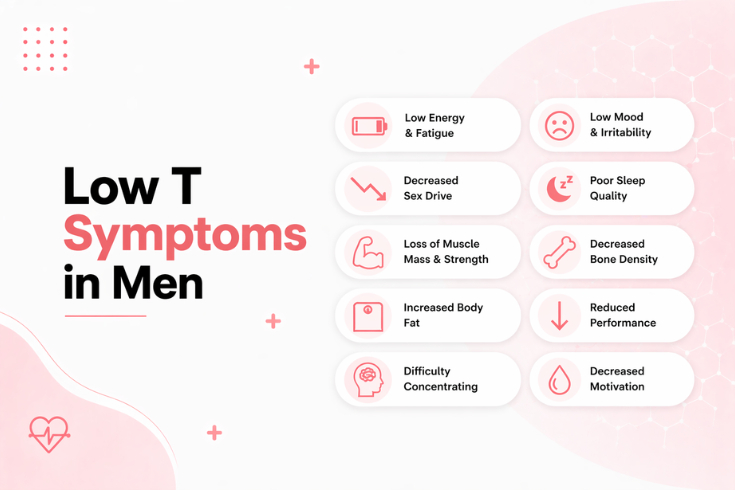
Most men don’t feel a sharp drop. They feel a slow fade less energy, less motivation, a sex drive that seems to have quietly packed up and left, and a mood that’s harder to describe than “depressed” but clearly isn’t right. For years, many men chalk this up to stress, getting older, or working too hard. That explanation feels plausible. And it keeps them from getting an answer.
Low testosterone in men also called male hypogonadism or low T is a condition where the testicles don’t produce enough testosterone to support normal physical, sexual, and mental function. Testosterone is the primary male sex hormone, responsible for muscle mass, bone density, sex drive, mood regulation, and cognitive sharpness. When levels drop below what the body needs, the result is a cluster of symptoms that can feel like depression, aging, or burnout — making low T one of the most underdiagnosed conditions in men. This guide covers every low testosterone symptom in men across physical, sexual, cognitive, and emotional domains — including why these symptoms are so often dismissed, why your labs can look “normal” while you still feel terrible, and exactly what to do next.
What Low Testosterone Does to Your Body
Testosterone is produced primarily in the testicles under direction from the pituitary gland in the brain. It circulates through the bloodstream, binding to receptors in muscle tissue, bone, the brain, and sexual organs. In adult men, it drives the maintenance of lean muscle, bone density, sperm production, red blood cell formation, and the hormonal signaling that controls libido and sexual function.
Production peaks in the late teens to early twenties and begins a gradual decline of roughly 1–2% per year after age 30. This slow decline is normal. But for many men including young men something disrupts the system more significantly, causing levels to fall into a range that genuinely impairs function.
When that happens, the effects are not isolated to one system. Testosterone receptors exist throughout the body. A significant drop affects sexual function, physical composition, mental sharpness, and emotional regulation — often simultaneously. The challenge is that each of these changes is subtle enough on its own to be explained away, and they tend to accumulate before any one symptom becomes impossible to ignore.
Low Testosterone Symptoms in Men: The Complete Picture
Low testosterone symptoms in men fall into four domains: sexual, physical, cognitive, and emotional. Most men with low T experience symptoms across several domains at once. No single symptom confirms the diagnosis but a cluster of symptoms across multiple areas is a strong signal.
Sexual Symptoms
The most recognized signs of low testosterone in men involve sexual function, and they’re often the first to appear.
Decreased libido: is the most reported symptom. This isn’t occasional disinterest — it’s a persistent, baseline absence of sexual desire that persists even in circumstances where it previously existed. Men describe it as their sex drive “just being gone” rather than reduced.
Erectile dysfunction: can occur with low T, though ED has multiple causes and low T is far from the only one. In low T specifically, the issue tends to involve spontaneous and morning erections becoming less frequent or absent, rather than performance anxiety or vascular causes. Loss of morning erections — which reflect nocturnal testosterone-dependent processes — is one of the more telling early indicators.
Reduced ejaculatory volume: and changes in orgasm quality are reported by many men with low T, though less discussed than libido and erections.
Infertility: low T suppresses the hormonal signal required for sperm production. For men in their 20s and 30s, this can be a primary concern that shapes treatment decisions.
Physical Symptoms
Fatigue that sleep doesn’t fix: is one of the most commonly reported low T symptoms. Men describe sleeping eight or nine hours and waking still drained. This is different from normal tiredness it persists through the day without a clear cause.
Loss of muscle mass: even with regular training is characteristic of low T. Testosterone is necessary for muscle protein synthesis. Men notice that they’re maintaining the same workout habits but losing strength, size, and recovery capacity. Muscle that used to come back easily after a break no longer does.
Increased body fat: particularly around the abdomen, accompanies the loss of muscle. The mechanism is partly metabolic — low T reduces the rate at which the body burns fat for fuel and partly hormonal, as fat cells convert testosterone to estrogen, worsening the deficit.
Reduced bone density: is a less-visible but medically significant consequence of prolonged low T. Testosterone stimulates bone mineral deposition. Over time, low T raises the risk of osteoporosis and stress fractures, particularly in men who go undiagnosed for years.
Body and facial hair changes: thinning or reduced growth — are associated with testosterone deficiency, though genetics play a significant role here.
Gynecomastia: (breast tissue development in men) can occur when the testosterone-to-estrogen ratio shifts. It affects a subset of men with low T and is sometimes one of the clearest visible indicators.
Cognitive Symptoms
This category is the most underrepresented in standard medical content, and it’s the one men on forums consistently describe as the most disruptive to daily life.
Brain fog: a term clinicians increasingly use to describe the cognitive dimension of low T — presents as difficulty concentrating, mental fatigue that doesn’t match physical fatigue, slowed thinking, and a reduced ability to hold multiple pieces of information in mind at once. Men describe it as thinking “through mud,” being unable to stay sharp in meetings they’d previously handled without effort, or reading the same paragraph three times.
Memory changes: specifically working memory and short-term recall — are reported by men with low T more frequently than clinical content acknowledges. Forgetting words mid-sentence, losing track of a thought, or struggling to retain new information are specific patterns that emerge.
Loss of motivation and drive: is categorically different from laziness. Men describe the disappearance of what felt like a fundamental appetite for effort — for projects, goals, physical challenges, creative work. This is not a mood problem in the traditional sense. It’s a loss of the motivational substrate that testosterone partly supports through dopaminergic pathways.
Emotional Symptoms
Irritability: a low-grade, persistent irritability that feels disproportionate and hard to explain — is one of the more common and relationship-damaging symptoms. Partners often notice this before the man himself does.
Depressed mood without clinical depression: is perhaps the most diagnostically confusing symptom of low T. Men experience a flattening of affect — not acute sadness, but a gray, low-affect state that lacks the quality of previously normal mood. They don’t feel depressed in the way they’d recognize; they feel “flat” or “like a muted version of myself.”
Reduced confidence and self-esteem: follow from the combination of physical changes, cognitive dullness, sexual dysfunction, and the sustained experience of underperforming relative to their own baseline.
Why Low Testosterone Symptoms Are So Easy to Dismiss
The onset is gradual. No one wakes up one morning with suddenly no sex drive or extreme fatigue. The decline happens over months or years, and at each stage there’s a reasonable-sounding alternative explanation: work stress, poor sleep, getting older, being out of shape. These explanations are not wrong — stress does cause fatigue, age does affect energy — which is precisely why they provide such effective cover.
Men are also trained, culturally and physiologically, to minimize the reporting of health symptoms. A man who tells his doctor he’s tired and unmotivated is not obviously flagging a hormonal disorder. He sounds like most men in their 40s. The overlap between low T and the generic presentation of “life is hard” means that many doctors and the men themselves don’t think to test.
There is also the partner observation problem. Many men first hear about the change from their partner, who has watched the shift in mood, energy, and personality over time and has more data than the man does. This is a real diagnostic pattern: the presenting complaint is often “my wife thinks something’s wrong with me,” and she’s right.
What Counts as Low Testosterone? Understanding the Numbers
The standard reference range for total testosterone in adult men is 300 to 1,000 nanograms per deciliter (ng/dL). A result below 300 ng/dL generally meets the clinical threshold for low testosterone. A result above 300 ng/dL is technically “normal.” The problem with this framing becomes obvious when you consider what the range represents: two men at opposite ends one at 310 ng/dL and one at 980 ng/dL — are both “in range,” but they are in physiologically completely different situations.
Total testosterone
Total testosterone is the most commonly ordered test but also the most incomplete in isolation. It measures the total amount of testosterone in the blood, including testosterone that is bound to proteins (primarily sex hormone-binding globulin, or SHBG) and unavailable for use by tissues.
Free testosterone
Free testosterone is what actually matters biologically the fraction not bound to SHBG, available to enter cells and exert effects. A man with a total testosterone of 420 ng/dL and high SHBG may have a free testosterone level that is functionally deficient, even though the headline number looks adequate. For this reason, a proper assessment includes both total and free testosterone, along with SHBG. Anything less gives an incomplete picture.
One more rule that most articles fail to mention: testosterone levels follow a daily rhythm, peaking in the early morning between 7 and 10 AM and dropping by as much as 30–40% by afternoon. A single blood draw at 2 PM can produce a result that significantly underestimates your actual peak level. Standard diagnostic practice requires a morning test and two separate tests on different days before a diagnosis is made.
What Causes Low Testosterone in Men?
Primary Hypogonadism (Testicular Origin)
Primary hypogonadism occurs when the testicles fail to produce adequate testosterone despite normal signaling from the brain. Causes include Klinefelter syndrome (an extra X chromosome), which is one of the most common genetic causes of low T in young men; testicular injury, torsion, or surgical removal; cancer treatment, as chemotherapy and radiation can permanently reduce testicular function; and undescended testicles in childhood that were not corrected.
Secondary Hypogonadism (Brain-Level Origin)
Secondary hypogonadism occurs when the pituitary gland or hypothalamus fails to send the hormonal signal that tells the testicles to produce testosterone. Causes include pituitary tumors or damage (including from head injury or surgery); long-term opioid use, which is one of the most common and least-discussed causes of low T in young men; obesity, where excess fat tissue converts testosterone to estrogen, suppresses pituitary function, and creates a reinforcing cycle; chronic stress and sleep deprivation, as cortisol and sleep both directly regulate testosterone production; prior anabolic steroid use; and type 2 diabetes and metabolic syndrome.
Age Related Decline
Testosterone naturally declines with age — roughly 1–2% per year after 30. But this natural decline becomes clinically significant sooner in some men, and the symptoms are not simply “aging normally.” Men with symptoms of low testosterone in their 30s, 40s, and 50s deserve evaluation, not dismissal.
Age is not a disqualifier for diagnosis. Low T is not exclusively a condition of men over 50. Young men in their 20s and 30s are increasingly diagnosed, often with identifiable causes that are treatable.
My Labs Say Normal But I Still Feel Terrible
This is the most common and the most poorly served clinical scenario in men’s health. A testosterone result of 380 ng/dL sits within the reference range. By the letter of the lab report, it is “normal.” But this number sits 70 points above the bottom of a 700-point range. A man who previously functioned at 750 ng/dL — which is entirely plausible has experienced an effective drop of nearly 50% even while technically remaining “in range.”
Many endocrinologists and urologists with expertise in men’s health now treat testosterone deficiency as a clinical diagnosis, not purely a laboratory one. This means that the combination of low-normal lab values and a cluster of genuine symptoms can justify treatment evaluation particularly when free testosterone is also in the lower portion of normal range. What to do if your labs come back “normal” but you still have symptoms:
- Request free testosterone and SHBG: if they were not included in your initial test. Total T alone is insufficient.
- Ask about your morning baseline: if the test was drawn in the afternoon, request a repeat draw between 7 and 10 AM.
- Request a second test: on a different day. Testosterone is variable; a single test cannot establish a reliable baseline.
- Document your symptoms specifically: A list of “I’m tired” carries less weight than “I have lost morning erections, my gym performance has declined by approximately 30%, I cannot focus for more than 20 minutes, and my mood is persistently flat for the past eight months.”
- Ask for a referral: to a urologist or endocrinologist who specializes in men’s hormonal health if your primary care physician is not engaging with your symptoms.
Low T or Something Else? Symptoms That Overlap
Several conditions produce symptom pictures that look nearly identical to low T. A proper evaluation rules these out before assuming testosterone is the problem or identifies them as co-occurring conditions, which is common.
| Symptom | Low T | Sleep Apnea | Vitamin D Deficiency | Thyroid Disorder | Depression |
|---|---|---|---|---|---|
| Fatigue | ✓ | ✓ | ✓ | ✓ | ✓ |
| Brain fog | ✓ | ✓ | ✓ | ✓ | ✓ |
| Low mood | ✓ | ✓ | ✓ | ✓ | ✓ |
| Low libido | ✓ | ✓ | — | ✓ | ✓ |
| Weight gain | ✓ | — | — | ✓ | — |
| Muscle loss | ✓ | — | ✓ | ✓ | — |
| Poor sleep | ✓ | ✓ | — | ✓ | ✓ |
| Morning erection loss | ✓ | ✓ | — | — | — |
| Bone density loss | ✓ | — | ✓ | ✓ | — |
Sleep apnea
deserves specific attention. Obstructive sleep apnea and low T have a bidirectional relationship: sleep apnea suppresses testosterone production by fragmenting the deep sleep cycles in which testosterone is released overnight. Meanwhile, low testosterone itself can worsen sleep apnea severity. Men with significant fatigue, brain fog, and morning erection loss — particularly those who snore, are overweight, or wake unrefreshed — should be evaluated for sleep apnea alongside hormonal testing.
Vitamin D deficiency
is extremely common and produces fatigue, muscle weakness, low mood, and cognitive symptoms that overlap substantially with low T. A 25-hydroxyvitamin D blood test costs very little and should be part of any evaluation for these symptoms.
Thyroid disorders
particularly hypothyroidism (underactive thyroid) produce a nearly identical symptom cluster to low T, including fatigue, brain fog, weight gain, muscle loss, low mood, and reduced libido. A TSH panel is standard in any workup for these symptoms. The takeaway is not that your symptoms are probably something else. It’s that you need a complete workup not just testosterone to know what you’re actually dealing with.
How to Get a Proper Low Testosterone Diagnosis
A diagnosis of testosterone deficiency requires at minimum: two fasting morning blood tests drawn on separate days, with results below 300 ng/dL on both, in the presence of symptoms. In practice, many clinicians will evaluate men whose symptoms are significant even with levels between 300 and 450 ng/dL.
Here is exactly how to approach the appointment:
-
Test in the morning: Request blood work drawn between 7 and 10 AM. Inform your doctor that you’d like a fasting testosterone draw. If your previous test was drawn in the afternoon, request a repeat.
-
Request the right panel: Ask for total testosterone, free testosterone, SHBG, LH (luteinizing hormone), FSH (follicle-stimulating hormone), estradiol, and prolactin. LH and FSH help distinguish primary from secondary hypogonadism. Prolactin screens for pituitary tumors. Estradiol assesses hormonal balance.
-
Request a complete metabolic panel: Ask for TSH (thyroid), 25-hydroxyvitamin D, CBC (complete blood count), and a basic metabolic panel. These rule out the overlapping conditions covered above.
-
Describe your symptoms specifically: Write them down before the appointment. Include duration, severity, and specific functional impairments. Specific documentation is more persuasive than general complaints.
-
Ask about a second test: If the first result is borderline (300–450 ng/dL), request a second draw on a different morning before accepting “you’re fine.”
-
Consider a specialist: If your primary care physician is dismissive of borderline results with significant symptoms, request a referral to a urologist or reproductive endocrinologist with specific experience in male hypogonadism. This is a reasonable and standard escalation.
What Happens If Low Testosterone Goes Untreated?
Low T is not a cosmetic problem or a quality-of-life issue that men simply need to push through. Untreated testosterone deficiency has documented downstream health consequences.
Cardiovascular risk
Testosterone plays a role in regulating cholesterol, insulin sensitivity, and blood pressure. Chronic low T is associated with increased risk of metabolic syndrome, type 2 diabetes, and cardiovascular disease. Research published in the Journal of Clinical Endocrinology & Metabolism has found associations between low testosterone and elevated mortality risk in men with cardiovascular disease.
Bone loss
Testosterone is necessary for bone mineral density. Men with untreated low T experience progressive bone loss that raises the risk of osteoporosis and fractures a risk that increases significantly in men who go undiagnosed for a decade or more.
Cognitive decline
Emerging research suggests that chronically low testosterone is associated with accelerated cognitive aging and poorer verbal memory, though causality has not been established definitively.
Mental health deterioration
The flat affect, anhedonia, and motivational loss of low T, if left unaddressed, progress. Men who dismiss these symptoms for years commonly report significant deterioration in life quality, career performance, and relationships.
Relationship consequences
Decreased libido, irritability, low confidence, and emotional flatness affect partnerships profoundly. In many cases, men whose symptoms went unrecognized for years report that the relationship damage was harder to repair than the hormonal deficit itself. None of these consequences are inevitable — and diagnosis followed by appropriate treatment can reverse or arrest most of them. But the window matters. The longer testosterone deficiency goes untreated, the more established the downstream effects become.
Frequently Asked Questions About Low Testosterone Symptoms in Men
Can low testosterone cause anxiety and depression?
Low testosterone is associated with depressed mood, irritability, and a flat emotional state — but it’s clinically distinct from major depressive disorder. Men with low T often describe feeling less like “sad” and more like emotionally muted or stripped of drive. Anxiety can also accompany low T, partly through sleep disruption and metabolic dysregulation. Some men diagnosed with depression are later found to have untreated hormonal deficiency as a primary contributor. Both conditions should be evaluated independently.
Can you have low testosterone in your 20s or 30s?
Yes. Low T is not exclusively a condition of older men. Causes including Klinefelter syndrome, pituitary dysfunction, anabolic steroid use, opioid use, obesity, and chronic stress can all drive testosterone deficiency in young men. Men in their 20s and 30s with testosterone deficiency symptoms deserve testing regardless of age. The dismissal of young men as “too young for low T” is common and often incorrect.
What is a normal testosterone level for a man?
The standard reference range for total testosterone is 300 to 1,000 ng/dL in adult men. However, this range is wide by design — two men at opposite ends are not in physiologically equivalent situations. Free testosterone (the biologically active fraction) and SHBG levels are necessary for a complete picture. Most clinicians consider values below 300 ng/dL clinically low, but symptom burden alongside borderline values (300–450 ng/dL) also justifies evaluation.
Can low testosterone cause brain fog?
Yes. Cognitive symptoms — including difficulty concentrating, slowed thinking, memory lapses, and reduced mental stamina — are a documented component of testosterone deficiency that most standard symptom lists underemphasize. Men describe brain fog as a consistent, baseline state rather than an occasional off day. Research supports testosterone’s role in supporting cognitive function through multiple mechanisms, including effects on dopaminergic and cholinergic signaling.
How is low testosterone diagnosed?
Diagnosis requires two fasting morning blood tests drawn on separate days, with results below 300 ng/dL and the presence of symptoms. Total testosterone, free testosterone, SHBG, LH, FSH, estradiol, and prolactin should all be included for a complete assessment. A single test drawn in the afternoon is insufficient for diagnosis.
What happens if low testosterone goes untreated?
Untreated low testosterone is associated with progressive bone density loss, increased cardiovascular and metabolic risk, cognitive decline over time, worsening mood and mental health, and relationship deterioration. The consequences are not immediate, but they accumulate. Diagnosis and appropriate treatment can reverse or arrest most downstream effects.
Can low testosterone cause weight gain?
Yes. Low T reduces the rate at which the body burns fat and decreases lean muscle mass — which in turn further reduces metabolic rate. The result is progressive abdominal fat accumulation even without significant changes in diet or activity. This creates a reinforcing cycle: fat tissue converts testosterone to estrogen, which further suppresses testosterone production.
Does sleep affect testosterone levels?
Yes, significantly. Testosterone production occurs primarily during deep sleep. Chronic sleep deprivation — even just five hours per night for one week — has been shown to reduce testosterone levels by 10–15% in young healthy men (University of Chicago research). Sleep apnea is a particularly significant disruptor because it fragments deep sleep throughout the night, even without the person being aware of it.
What’s the difference between total and free testosterone?
Total testosterone measures all testosterone in the blood, including the majority that is bound to proteins — primarily SHBG — and therefore biologically unavailable. Free testosterone is the unbound fraction that can actually enter cells and exert hormonal effects. A man can have a total testosterone in the “normal” range but a functionally low free testosterone if SHBG is elevated. This is why testing both values matters.
Can I increase testosterone naturally without medication?
Certain lifestyle interventions have modest but documented effects on testosterone levels: consistent resistance training, adequate sleep (7–9 hours), achieving a healthy body weight, reducing chronic stress, and correcting Vitamin D deficiency. These interventions support natural production and should be part of any evaluation. However, they are insufficient to restore levels in men with true hypogonadism — meaning a structural or endocrine cause — and should not substitute for evaluation if symptoms are significant.
If your symptoms match what’s described here, the next step is getting a proper diagnosis — and understanding your treatment options before that appointment. Read our complete guide to testosterone replacement therapy to learn how TRT works, who it’s right for, and what to expect from diagnosis through the first months of treatment.