
TRT Guide
TRT for Age Related Low Testosterone: What the FDA Says and When It’s Appropriate
The FDA doesn’t approve TRT for age-related low testosterone — but doctors prescribe it off-label every day. Here’s the clinical evidence, the LOH criteria,…
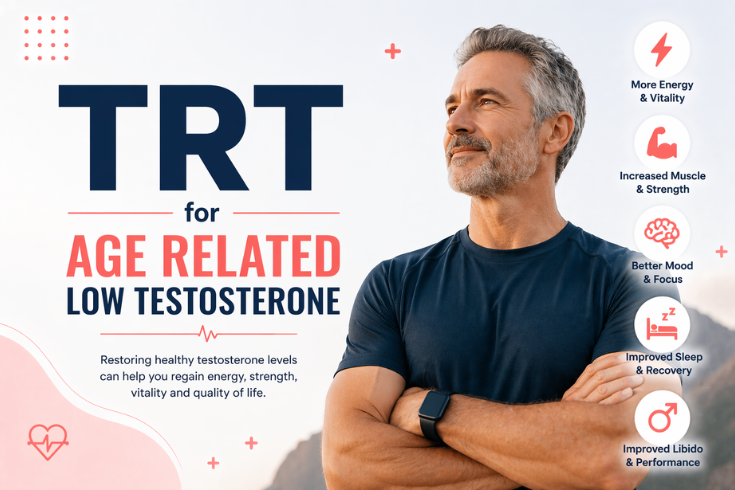
Your doctor ran labs. Your total testosterone came back at 260 ng/dL below the typical clinical threshold. He mentioned it, maybe suggested lifestyle changes, and moved on. You left the office unsure whether you qualified for treatment or whether “age-related decline” meant you were just supposed to accept it.
Tens of millions of American men are in that exact position. Testosterone declines naturally as men age — at roughly 1.6% per year after the mid-30s — and the symptoms (low libido, fatigue, loss of muscle mass, erectile dysfunction) are real, documented, and treatable in the right clinical context. The complication is a regulatory and clinical distinction that most doctors handle poorly and most health websites ignore entirely.
Age-related testosterone decline is the gradual reduction in testosterone that occurs naturally as men age, typically beginning around 35 and progressing at roughly 1.6% per year. Unlike classic hypogonadism where the testes or pituitary fail due to a specific medical condition — age-related decline has no single identifiable cause. Whether it requires treatment, and whether that treatment is FDA-approved, depends on a specific combination of symptoms and lab values that most men and many doctors don’t fully understand. This article covers what the FDA actually approved (and what it explicitly did not), the clinical framework doctors use to move from “your T is low” to “treatment is appropriate,” and what the best-available trial evidence shows about TRT in older men.
How Testosterone Declines With Age: The Physiology Behind the Numbers
Testosterone doesn’t fall off a cliff at 50. The decline is gradual, starts earlier than most men expect, and involves changes at multiple points in the body’s hormonal signaling chain. Studies using within-person longitudinal measurements the more clinically accurate method — show total testosterone falling at approximately 1.6% per year from the mid-30s onward, according to research published in the Journal of Clinical Endocrinology and Metabolism (Wu et al., 2008). Cross-sectional population data shows a more modest 0.4% per year, but that figure averages across cohorts with vastly different health profiles. The longitudinal rate is the one that matters for an individual man’s trajectory.
Free testosterone the biologically active fraction not bound to proteins declines faster, at about 1.3% per year. This happens for a reason most men and their doctors don’t discuss: as men age, levels of sex hormone-binding globulin (SHBG) increase. SHBG binds testosterone in the bloodstream, rendering it unavailable to tissues. A man with a “normal” total testosterone level can still have meaningfully low free testosterone because more of it is tied up. This is why a complete hormonal workup for an older man should include both measurements.
The underlying mechanism involves changes throughout the hypothalamic-pituitary-gonadal (HPG) axis — the chain of signaling that runs from the brain to the testes. Research shows the hypothalamus produces less gonadotropin-releasing hormone (GnRH) with age, reducing the downstream signal to produce testosterone. Leydig cells in the testes also accumulate cellular damage over time, further impairing production even when properly stimulated. Neither the brain nor the testes fail completely they just work less efficiently. That’s a fundamentally different situation from classic hypogonadism, and it’s why the FDA treats them differently.
Classic Hypogonadism vs. Age-Related Low T: Why the Distinction Matters
This distinction is the fulcrum of the entire FDA debate and most patients never hear it explained clearly. Classic hypogonadism comes in two forms. Primary hypogonadism involves failure of the testes themselves — caused by Klinefelter syndrome, testicular injury, chemotherapy, radiation, or autoimmune disease. Secondary hypogonadism involves a failure in the pituitary or hypothalamic signaling caused by pituitary tumors, opioid use, certain medications, or obesity-related hormonal suppression. Both forms have an identifiable pathological cause. Both are FDA-approved indications for testosterone replacement therapy.
Age-related testosterone decline has no single identifiable pathological cause. The decline is physiological it happens in virtually all men, varies by individual, and doesn’t map cleanly onto a disease model. The Endocrine Society and others coined the term late-onset hypogonadism (LOH) in 2002 to describe a clinical syndrome that sits somewhere between pure aging and diagnosable disease. LOH has specific criteria (covered in the next section), but the key point is that it is not a recognized FDA indication.
The table below shows how these categories compare across dimensions that matter clinically and financially.
| Dimension | Classic Hypogonadism | Age-Related Low T / LOH |
|---|---|---|
| Cause | Testicular failure or pituitary dysfunction | Gradual physiological decline with aging |
| FDA-approved indication | Yes — primary and secondary hypogonadism | No — off-label only (post-2015) |
| Testosterone threshold | <300 ng/dL (two morning measurements) | <300–320 ng/dL + specific symptom criteria |
| Symptom requirement | Yes, consistent with low T | ≥3 specific sexual symptoms required for LOH |
| LH/FSH pattern | Abnormal (elevated in primary; low in secondary) | Often normal to mildly elevated |
| Insurance coverage | Usually covered with documentation | Frequently denied; out-of-pocket |
| Treatment recommendation | Standard of care | Individualized basis (Endocrine Society 2018) |
Source: Endocrine Society Clinical Practice Guideline, 2018; FDA Class-Wide Labeling Changes, March 2015; Wu et al., NEJM, 2010
The insurance column matters practically. Men whose low T is attributed to age-related decline frequently find testosterone therapy denied by insurers because it falls outside the FDA-approved indication even when their labs and symptoms would otherwise justify treatment under the Endocrine Society’s criteria.
What the FDA Actually Says About Testosterone and Aging
In March 2015, the FDA issued class-wide labeling changes for all approved testosterone products. The core change was a new Limitation of Use statement added to the indications section of every testosterone product on the US market. The language added to product labels states directly: “Safety and efficacy of [testosterone product] in men with ‘age-related hypogonadism’ (also referred to as ‘late-onset hypogonadism’) have not been established.”
This was a deliberate regulatory carve-out. Before 2015, testosterone was routinely prescribed for age-related decline — in part because of direct-to-consumer marketing campaigns and in part because the clinical distinctions weren’t enforced at the regulatory level. Between 2001 and 2011, testosterone prescriptions in the US tripled. The FDA convened an advisory committee in September 2014 to assess whether this prescribing pattern was appropriate, given emerging signals about cardiovascular risk from six clinical studies (with conflicting results). The committee concluded that the available evidence supported TRT only for men with classic hypogonadism — not for age-related decline.
The 2015 label change did two things. It removed age-related and idiopathic hypogonadism from the approved indications. And it required manufacturers to conduct additional postmarket clinical trials specifically addressing cardiovascular risk which eventually produced the landmark TRAVERSE trial, published in NEJM in 2023. (The TRAVERSE trial’s cardiovascular findings are covered in full in our separate analysis of TRT and heart risk.) What the FDA ruling did NOT do is prohibit physicians from prescribing testosterone for age-related low T. Off-label prescribing is legal and common throughout medicine. It does mean that insurers have a regulatory basis to deny coverage, that prescribing physicians take on additional responsibility for informed consent, and that men receiving TRT for age-related decline are doing so without the same evidentiary backing as men with classic hypogonadism.
Late-Onset Hypogonadism: The Clinical Framework Doctors Use
Late-onset hypogonadism (LOH) is the clinical entity that occupies the space between pure age-related decline and classic hypogonadism. It was formally defined in a landmark 2010 study published in the New England Journal of Medicine (Wu et al.) — a study involving 3,369 men aged 40–79 across eight European countries, which remains the reference definition used in clinical practice.
According to that study, LOH requires all three of the following:
- The presence of at least three specific sexual symptoms: decreased morning erections, decreased sexual thoughts (frequency of sexual desire), and erectile dysfunction
- Total testosterone below 320 ng/dL (11 nmol/L)
- Free testosterone below 64 pg/mL (220 pmol/L)
This is a stricter and more specific standard than “your T level is below 300.” Many men walk into a doctor’s office with fatigue and low libido, receive a testosterone test, and get prescribed TRT on the basis of a single low total T reading. That’s not the diagnostic process the clinical evidence supports. LOH requires symptom specificity (specifically sexual symptoms, not just fatigue) plus both total and free testosterone below defined thresholds — on at least two separate early morning fasting measurements.
The free testosterone threshold matters especially for older men. Because SHBG rises with age, two men with identical total testosterone levels of 280 ng/dL can have meaningfully different amounts of bioavailable testosterone. A 65-year-old with high SHBG will have substantially less free T than a 40-year-old with the same total T number. This is why checking free testosterone or calculating it from total T and SHBG — is part of an accurate age-related low T workup, even though many primary care labs run only total testosterone as the default.
It’s also worth noting what LOH does not require: a specific pathological cause. The framework acknowledges that aging itself is a contributing factor. This is the clinical bridge that allows physicians to move from “age-related decline” to “treatable condition” — not by inventing a disease, but by applying specific diagnostic criteria that identify men whose symptoms and lab values cross a threshold where evidence supports treatment.
What the Testosterone Trials Found About TRT in Men 65 and Older
The Testosterone Trials (T Trials) are the most rigorous clinical evidence available on TRT specifically in older men with low T. Funded by the NIH and coordinated by the University of Pennsylvania, the T Trials enrolled 790 men aged 65 and older with a serum testosterone below 275 ng/dL and symptoms consistent with low T. Participants were randomized to testosterone gel or placebo gel for one year.
The results, published in the New England Journal of Medicine in 2016, showed:
Sexual function
Testosterone therapy produced a significant and meaningful improvement in sexual activity, sexual desire, and erectile function compared to placebo. This was the trial’s most robust finding.
Physical function
The testosterone group showed greater improvement in 6-minute walking distance when data from all three concurrent physical function trials was combined, though the differences were modest.
Vitality
No significant improvement in energy or vitality compared to placebo. This is a finding that surprises many men who expect TRT to restore energy levels — the evidence for that specific benefit in older men is weak.
Mood
Slightly improved mood and lower depression scores in the testosterone group, though the clinical magnitude was modest.
Safety
No significant difference in major adverse cardiovascular events, prostate cancer, or other serious adverse events between the treatment and placebo groups. Importantly, the trial was not powered to detect cardiovascular differences — it was too small and too short to draw conclusions about long-term CV risk in this population. Erythrocytosis (elevated red blood cell count) occurred more frequently in the testosterone group, consistent with what other studies show.
The T Trials are the reason the Endocrine Society’s 2018 clinical practice guideline says testosterone may be offered to men 65 and older with consistently low testosterone and specific symptoms or conditions — but recommends against routinely prescribing it to all older men with low T. The evidence supports targeted use in the right candidate, not population-wide treatment of age-related decline.
When TRT for Age-Related Low T Is Clinically Appropriate
Based on the Endocrine Society 2018 guidelines, the T Trials data, and standard clinical practice, here is what an evidence-based candidate profile looks like for age-related low T.
Criteria that support treatment:
- Two early morning fasting total testosterone measurements below 300 ng/dL (some clinicians use 320 ng/dL per the LOH criteria)
- Free testosterone confirmed low, especially if total T is in the 270–310 ng/dL range
- Specific hypogonadal symptoms — ideally the three sexual symptoms from the Wu et al. LOH criteria, though persistent fatigue, loss of muscle mass, or unexplained anemia also support evaluation
- Other potential causes of low T have been addressed or ruled out (obesity, obstructive sleep apnea, opioid or corticosteroid use, poorly controlled diabetes, hypothyroidism)
- No absolute contraindications: no active or suspected prostate cancer, no severe untreated sleep apnea, no severe or decompensated heart failure, hematocrit below 50%
- Patient has been informed about the off-label status, available evidence (including TTrials), monitoring requirements, and contraindications to fertility treatment
Criteria that argue against treatment:
- Testosterone levels in the normal range (above 400 ng/dL) with no specific diagnosis — optimization of normal T is not an evidence-supported indication
- Untreated obesity or metabolic syndrome that may be suppressing T independently; weight loss alone can restore levels to normal range in many men
- Active fertility goals — testosterone therapy suppresses sperm production (often severely); men who want to preserve fertility should discuss their options before starting
- Unresolved absolute contraindications
- Symptoms more consistent with depression, sleep disorders, or thyroid dysfunction that have not been evaluated
The Endocrine Society explicitly recommends “individualized basis” which in practice means a clinician who takes time to review the full clinical picture, not a telehealth visit that results in a prescription based on a single test and a symptom checklist.
Frequently Asked Questions
Is testosterone therapy FDA-approved for age-related low testosterone?
No. In March 2015, the FDA issued class-wide labeling changes requiring all testosterone products to add a Limitation of Use statement specifying that safety and efficacy in men with “age-related hypogonadism” have not been established. Testosterone is FDA-approved only for men with classic hypogonadism — primary or secondary — with a known underlying medical cause. Prescribing TRT for age-related decline is legal but off-label.
What is late-onset hypogonadism, and how is it different from regular hypogonadism?
Late-onset hypogonadism (LOH) is a clinical syndrome defined in 2010 by Wu et al. in the New England Journal of Medicine as the combination of at least three specific sexual symptoms (decreased morning erections, reduced sexual desire, erectile dysfunction) plus total testosterone below 320 ng/dL and free testosterone below 64 pg/mL. Classic hypogonadism requires a specific pathological cause — testicular failure or pituitary dysfunction. LOH does not require an identifiable cause beyond aging; it requires that specific symptom-lab combination.
What testosterone level qualifies a man over 50 for TRT?
There is no single universal threshold. The most commonly used clinical cutoff is 300 ng/dL total testosterone, measured on two separate early morning fasting samples. The Wu et al. LOH definition uses 320 ng/dL total plus 64 pg/mL free testosterone. The Endocrine Society requires that the level be “unequivocally and consistently low” and accompanied by symptoms. A single borderline low result is not sufficient basis for treatment.
Can my doctor still prescribe TRT even if my low T is age-related?
Yes. Off-label prescribing is legal in the United States. A physician can prescribe testosterone for age-related low T if they determine it is medically appropriate, document informed consent about the off-label status, and establish a monitoring plan. The practical complication is insurance — many plans deny coverage for age-related low T prescriptions after the 2015 FDA label change, leaving patients to pay out of pocket.
What did the Testosterone Trials show about TRT in men over 65?
The TTrials enrolled 790 men aged 65 and older with testosterone below 275 ng/dL. Over one year, testosterone therapy produced significant improvements in sexual function, sexual desire, and erectile function compared to placebo. Physical function improved modestly. Vitality did not improve significantly. There was no significant difference in major cardiovascular events between groups, though the trial was not powered to detect cardiovascular differences. The results support targeted use in symptomatic men with confirmed low T — not routine prescribing for all older men with declining levels.
Why does free testosterone matter more than total testosterone as men age?
As men age, levels of sex hormone-binding globulin (SHBG) increase — the protein that binds testosterone in the bloodstream and makes it unavailable to tissues. Because of this, total testosterone can appear borderline while free testosterone — the biologically active fraction — is meaningfully low. Two men with identical total testosterone levels of 285 ng/dL can have substantially different amounts of active hormone. Measuring free testosterone, or calculating it from total T and SHBG, is particularly important for men in their 50s and 60s.
What are the risks specific to TRT in older men?
Erythrocytosis — an elevation in red blood cell count — is the most common dose-related adverse effect and occurs more frequently in older men on TRT. It requires monitoring with periodic hematocrit measurements and may require dose reduction or discontinuation. Older men also have higher baseline cardiovascular risk, which is why the current evidence (including the TRAVERSE trial) and the Endocrine Society’s individualized-basis recommendation are important — TRT is not appropriate for every older man with low T, and risks must be weighed individually.
The Science Here Is Settled Enough to Act On If the Criteria Fit
The FDA’s 2015 ruling wasn’t a statement that TRT doesn’t work for older men. It was a statement that the evidence at the time didn’t justify broad population-level approval for age-related decline as an indication. The Trials — published the following year — added clarity: TRT produces real, meaningful benefits in older men with low T and specific symptoms, particularly in sexual function. It doesn’t restore the energy and vitality that direct-to-consumer marketing promised, but it does what the clinical data actually shows.
For men in the gray zone — testosterone confirmed low on two measurements, specific hypogonadal symptoms present, other causes ruled out — the off-label status is a regulatory designation, not a clinical verdict. The Endocrine Society’s position is clear: individualized treatment is appropriate for the right candidate, after an honest conversation about what the evidence supports and what it doesn’t.
If your labs show consistently low testosterone and you’re experiencing the symptoms described here, the next step is a candid conversation with an endocrinologist or urologist — one familiar with the T Trials data and the Endocrine Society’s 2018 guidelines. Read our complete guide to testosterone replacement therapy for a full breakdown of treatment options, monitoring protocols, and what to expect in year one.