
TRT Guide
What Happens If Testosterone Is Not Injected into the Muscle Complete TRT Injection Guide
Testosterone not injected into the muscle causes absorption failures, hormone swings, and serious risks. Learn exactly what happens — and how to inject…
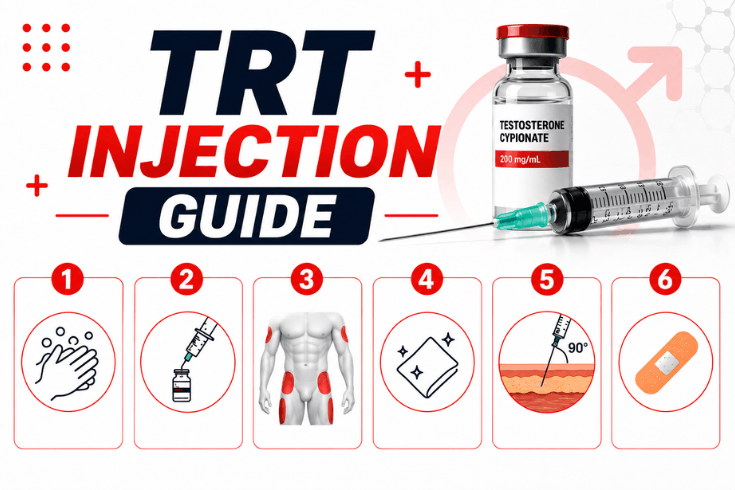
Testosterone injections given outside the intended tissue absorb differently, produce unpredictable hormone levels, and in rare cases create serious medical emergencies. This guide explains precisely what happens when a testosterone shot lands in the wrong tissue and gives you the complete injection framework so it does not happen again.
A testosterone injection (also called an inj testosterone or a testosterone shot) is an oil-based hormone dose delivered either into muscle tissue (intramuscular, or IM) or into the fatty tissue just below the skin (subcutaneous, or SubQ). The method, site, needle length, and angle all determine whether the hormone absorbs correctly, whether blood levels stay stable, and whether complications occur.
Whether you are new to at home testosterone injections or troubleshooting inconsistent lab results on an existing protocol, this guide covers the full picture: consequences of injection errors, the correct IM and SubQ techniques, every testosterone injection site, how to select the right needle size, and the most common mistakes that send testosterone into the wrong tissue.
What Actually Happens When a Testosterone Injection Misses the Muscle
When a testosterone injection does not reach muscle tissue, three distinct situations can occur depending on where the oil actually lands.
Scenario 1: Testosterone injected into subcutaneous fat (most common)
This is the most frequent injection error, particularly for patients using a needle that is too short for their body composition. When an oil-based testosterone formulation deposits into fatty tissue instead of muscle, absorption slows significantly. The oil sits in the fat layer, releases gradually, and produces lower peak testosterone levels than an equivalent IM dose.
For patients on a prescribed IM protocol, an accidental SubQ injection does not destroy the dose entirely — testosterone still absorbs. However, the absorption timeline, peak concentration, and hormone stability differ from what an IM injection produces. If this happens repeatedly, weekly lab results will trend lower than expected and clinicians will often increase dose before identifying the actual cause.
One important distinction: subcutaneous injection is also a valid intentional method (covered in detail below). The problem is not SubQ absorption itself — it is unintended SubQ absorption when the protocol specifies IM.
Scenario 2: Testosterone injected directly into a blood vessel
This is rare during standard IM injection, but it is the most medically serious outcome. Testosterone cypionate and enanthate are oil-based formulations. If the oil enters the bloodstream in significant volume, it can form a fat embolism — a clot of oil that travels through the circulatory system and can reach the lungs or brain. Symptoms include sudden chest pain, shortness of breath, dizziness, or loss of consciousness immediately after injection.
This is why many injection protocols still recommend aspiration (pulling the plunger back before injecting to check for blood return) even though major medical organizations no longer universally require it. If you aspirate and see blood in the syringe, withdraw the needle immediately, apply pressure, and do not inject at that site. Seek medical evaluation if symptoms develop after any injection.
Scenario 3: Injection near a nerve
Injecting near the sciatic nerve — a risk specific to the dorsogluteal (traditional upper-outer buttock) site can cause sharp electric pain down the leg, temporary numbness, or in severe cases temporary paralysis of the lower limb. This is one reason modern TRT protocols favor the ventrogluteal site, which sits away from the sciatic nerve path.
What to do immediately if you suspect you missed the muscle:
- Do not re-inject the same dose — you have still received testosterone, just with altered absorption
- Monitor hormone levels at your next scheduled lab test
- If you experience chest pain, difficulty breathing, or sudden neurological symptoms after any injection, seek emergency care immediately
- If a painful lump forms at the site over the following days, contact your prescribing clinician this may indicate an oil granuloma or local infection requiring evaluation
Intramuscular vs Subcutaneous Testosterone Injection What the Research Shows
The distinction between intramuscular and subcutaneous testosterone injection matters more than most online guides acknowledge. A peer-reviewed clinical review published in the Journal of Clinical Endocrinology and Metabolism found that subcutaneous testosterone cypionate and enanthate produce stable, predictable on-treatment concentrations comparable to traditional IM delivery, with 92.7% of participants achieving target testosterone ranges (300–1,100 ng/dL) at week 12. The key mechanism: subcutaneous fat has extensive lymphatic drainage that produces a gradual, stable release profile, while intramuscular injection produces a faster absorption peak.
This does not make SubQ superior. It makes them different tools suited to different protocols.
| Dimension | Intramuscular (IM) | Subcutaneous (SubQ) |
|---|---|---|
| Injection depth | 1–1.5 inches into muscle | 5/8 inch into fatty tissue |
| Needle gauge | 22–23G injection needle | 23–25G injection needle |
| Absorption speed | Rapid (peaks 24–48 hours) | Gradual (flatter curve) |
| Hormone level stability | Pronounced peaks and troughs | More stable, predictable levels |
| Maximum volume per injection | Up to 3 mL | Up to 1–2 mL |
| Pain level | Moderate (muscle soreness after) | Low (surface tissue only) |
| Self-injection ease | Moderate (glute requires technique) | Easier (abdomen or thigh, visible) |
| Suitable for testosterone cypionate | Yes | Yes — clinically validated |
| Suitable for testosterone enanthate | Yes | Yes |
| Best for | Standard TRT, higher-volume doses | Frequent lower-dose schedules, comfort-priority patients |
The question of whether it is better to inject testosterone subcutaneously or intramuscularly does not have a single answer. Patients who inject twice weekly or more often tend to prefer SubQ for comfort and convenience. Patients on weekly protocols with higher volumes typically use IM. Your prescribing clinician should determine which method your specific formulation and dose support.
Testosterone Injection Sites Where to Inject for IM and Sub Q
Choosing the right testosterone injection site affects absorption consistency, injury risk, and how easily you can self-inject without a second person. These are the validated IM and SubQ test injection sites used in clinical TRT protocols.
Ventrogluteal (Hip) Preferred IM Site
The ventrogluteal site is the recommended first-choice injection location for most modern TRT protocols. To locate it: place your hand on your hip with your thumb pointing toward your groin and your fingers toward your back. The injection site sits in the V-shaped triangle between your index and middle fingers. This site sits away from the sciatic nerve and gluteal blood vessels, has less subcutaneous fat than the dorsogluteal site, and handles volumes up to 2–3 mL well. It is also reachable for self-injection, unlike the traditional dorsogluteal.
Dorsogluteal (Upper Outer Buttock) Classic IM Site
The traditional “upper outer quadrant of the buttock” injection remains widely used but carries higher sciatic nerve proximity risk than the ventrogluteal site. If using this site, stay strictly in the upper outer quadrant. It requires a second person for self-injection, which is a practical limitation for at home testosterone injections.
Vastus Lateralis (Outer Thigh) Preferred Self-Injection IM Site
The outer middle third of the thigh (vastus lateralis muscle) is the most accessible site for self-injection. Sit down, identify the middle of the thigh, move to the outer side, and inject into the muscle bulk. It handles volumes up to 2 mL. Many patients report it as the easiest site to self-inject accurately.
Deltoid (Shoulder) IM Site for Smaller Volumes
The deltoid handles a maximum of 1 mL and is not suitable for typical weekly testosterone doses above 0.5 mL. Locate the injection zone two finger-widths below the acromion (the bony top of the shoulder). Useful for very frequent small-dose protocols only.
SubQ Sites Abdomen and Thigh
For subcutaneous testosterone injection, the two primary sites are:
- Abdomen: 3–5 cm (about two finger-widths) to either side of the navel, pinching a fold of skin
- Outer thigh: Middle outer portion of the upper thigh, pinching a fold away from the deeper muscle
Both SubQ sites are easy to visualize and self-administer. Rotate between them to prevent lipohypertrophy the formation of fatty lumps from repeated injection at the same point.
How to Give a Testosterone Injection Step-by-Step IM Protocol
This protocol applies to standard intramuscular self injection testosterone at home. Read it fully before your first self-injection.
Equipment you need:
- Testosterone vial (prescribed formulation)
- 18G drawing needle + 22–23G, 1–1.5 inch injection needle (or as prescribed)
- 1 mL or 3 mL Luer-Lock syringe
- Alcohol swabs
- Sterile gauze pads
- Sharps disposal container
Step 1: Wash your hands
Wash with soap and water for at least 20 seconds. This is the single most effective infection prevention step.
Step 2: Gather and inspect supplies
Check the expiration date on your testosterone vial. Inspect the solution — if it appears cloudy, contains particles, or has changed color, do not use it.
Step 3: Wipe the vial top with an alcohol swab
Let it air-dry for 15 seconds before inserting the drawing needle.
Step 4: Draw the testosterone
Attach the 18G drawing needle to your syringe. Draw air equal to your dose volume into the syringe. Insert the 18G needle into the vial, inject the air, then invert the vial and draw slightly more than your prescribed dose. Remove air bubbles by flicking the syringe and pushing the plunger to the exact dose line.
Step 5: Switch to your injection needle
Remove the 18G drawing needle and attach your 22–23G injection needle. The fresh needle is sharper and less prone to causing soreness.
Step 6: Select and prepare your injection site
Identify your site using the landmarks described in the section above. Wipe the area with an alcohol swab. Let it air-dry completely — injecting through wet alcohol increases sting.
Step 7: Adjust needle length for your body composition
This step is the one most guides skip, and it is the most common reason testosterone lands in fat instead of muscle. A standard 1-inch needle reaches muscle in men with lean-to-average body composition. For men with more body fat — particularly at the injection site — a 1.5-inch needle may be required to consistently clear the subcutaneous fat layer and reach the muscle. If your testosterone levels have been consistently lower than expected on a standard protocol and you inject into the glute or thigh, needle length is worth discussing with your prescribing clinician.
Step 8: Insert and inject
Hold the syringe like a dart. Insert at 90 degrees to the skin with a single smooth motion. Push the plunger slowly and steadily — injecting oil too quickly increases discomfort. For a 1 mL dose, 10–15 seconds is appropriate.
Step 9: Withdraw, apply pressure, and dispose
Remove the needle at the same angle as insertion. Apply gentle pressure with a gauze pad — do not rub, as rubbing disperses oil unevenly. Dispose of the used needle immediately in your sharps container.
Subcutaneous Testosterone Injection Sites and How to Inject SubQ
Subcutaneous testosterone injection is not an injection error it is a validated clinical method. Testosterone cypionate injected subcutaneously produces therapeutic hormone levels. A 2022 clinical review in the Journal of Clinical Endocrinology and Metabolism confirmed this with data across both cypionate and enanthate formulations.
Can you inject testosterone cypionate subcutaneously?
Yes. Testosterone cypionate is one of the two most studied esters for subcutaneous administration. SubQ cypionate produces stable testosterone levels with a 23–25G needle at 5/8-inch length. The slower absorption from SubQ tissue reduces the peak-to-trough swings that some IM patients experience mid-week.
SubQ Injection Sites:
Abdomen: Pinch 1–2 inches of skin at least 3 cm from your navel. The injection goes into the pinched fold, not flat against the skin. Avoid injecting into the same point consecutively — rotate around the navel clockwise to create a systematic rotation.
Outer thigh: Pinch the outer mid-thigh tissue. This site has slightly more tissue depth than the abdomen in most patients and is an effective alternative for those who find the abdomen uncomfortable.
Step-by-step SubQ technique:
- Prepare equipment and vial as described in the IM steps above
- Use a 23–25G, 5/8-inch needle attached to a 1 mL syringe
- Pinch 1–2 inches of skin at your chosen site
- Insert the needle at 90 degrees into the pinched tissue
- Release the pinch once the needle is inserted
- Inject slowly (15–20 seconds for a 0.5 mL dose)
- Withdraw at the same angle, apply light pressure, dispose of the needle
SubQ injections should not be performed with testosterone doses above 1–1.5 mL without clinical guidance, as larger oil volumes in subcutaneous tissue increase the risk of granuloma formation.
What Size Needle for Testosterone Injection Gauge, Length, and Syringe
Needle selection is where most injection errors begin. Using the wrong gauge, the wrong length, or the same needle to draw and inject are all correctable mistakes.
Drawing needle vs injection needle
Always use two needles. An 18G drawing needle pulls viscous testosterone oil through the vial’s rubber stopper without difficulty. Then switch to a finer injection needle — the drawing needle has a blunted tip after puncturing the stopper and causes unnecessary tissue damage if used to inject.
Needle gauge by method
| Method | Recommended Gauge | Notes |
|---|---|---|
| Drawing (all methods) | 18G | Wide enough to pull oil quickly |
| IM injection — glute or quad | 22–23G | Standard balance of flow speed and comfort |
| IM injection — deltoid | 23–25G | Smaller site; finer needle reduces tissue stress |
| SubQ injection | 23–25G | Shallow tissue; finer needle reduces surface pain |
Needle length by site and body composition
| Site | Lean/Average Build | Higher Body Fat |
|---|---|---|
| Ventrogluteal or dorsogluteal | 1 inch | 1.5 inches |
| Vastus lateralis (quad) | 1 inch | 1–1.5 inches |
| Deltoid | 1 inch | 1 inch max |
| SubQ (abdomen or thigh) | 5/8 inch | 5/8 inch |
Syringe size
A 1 mL syringe provides better dose precision for doses under 1 mL. A 3 mL syringe handles higher volumes (1–3 mL) without precision loss for standard doses. Use a Luer-Lock syringe to prevent the needle from detaching during injection.
Common Mistakes That Send Testosterone Into the Wrong Tissue
Most injection failures trace to a small set of correctable errors.
Using a needle too short for body composition: A 1-inch needle reaches the gluteal muscle in men with lean to moderate body composition. In men with higher body fat at the injection site, the same needle may deposit entirely in subcutaneous fat. This is the leading cause of unexpectedly low testosterone levels on a protocol that looks correct on paper. Switching to a 1.5-inch needle resolves the issue.
Wrong injection angle: Intramuscular injection requires a 90-degree angle to the skin surface. Angling the needle — even slightly — reduces the effective depth and increases the chance of an oblique path through subcutaneous fat. SubQ injection also uses 90 degrees into the pinched fold; the difference is what you are injecting into, not the angle.
Injecting the quad incorrectly: The vastus lateralis is on the outer side of the thigh. Injecting into the front (rectus femoris) or inner thigh increases discomfort and proximity to the femoral nerve and blood vessels. Stay on the outer mid-thigh for all quad injection protocols.
Injecting too fast: Pushing oil too quickly forces the formulation into surrounding tissue and causes more post-injection discomfort. A slow, steady plunger movement over 10–20 seconds distributes the oil properly and reduces next-day soreness.
Not rotating test injection sites: Repeated injection at the same anatomical point causes lipohypertrophy — firm, desensitized fatty nodules that alter absorption. A structured rotation using at least 4–6 distinct sites prevents this.
Injecting through wet alcohol: Wiping with an alcohol swab and injecting immediately — before the alcohol evaporates — causes unnecessary burning. Let the site dry for at least 10–15 seconds.
Managing TRT Injections at Home With Confidence
The difference between a testosterone injection that works and one that falls short almost always comes down to three things: reaching the correct tissue depth, using the right needle for your body, and rotating sites consistently. When testosterone does not reach the muscle on an IM protocol, levels drop, fatigue sets in, and many patients assume their dose needs adjustment — when the real fix is needle selection or site technique.
If you are managing TRT at home and want a personalized injection protocol reviewed by a specialist — including site selection, needle sizing, and dose schedule book a clinical review with the TRT Foundation team.
Frequently Asked Questions About Testosterone Injections
What happens if testosterone is accidentally injected subcutaneously instead of into the muscle?
The dose still absorbs, but more slowly and with lower peak concentration than an IM injection of the same volume. Hormone levels for that week may be lower than your baseline. A single accidental SubQ injection does not require a corrective dose just monitor levels and correct your technique for the next injection. If accidental SubQ injections are recurring, switch to a longer needle or evaluate your site selection.
Is it better to inject testosterone subcutaneously or intramuscular?
Neither is universally better. SubQ produces more stable, lower-peak hormone levels and is easier to self-administer. IM produces faster absorption and handles larger volumes. The best method depends on your prescribed formulation, dose volume, and dosing frequency. Both are clinically validated. Discuss the decision with your prescribing clinician rather than switching methods unilaterally.
Can you inject testosterone cypionate subcutaneously?
Yes. Testosterone cypionate is one of the most studied esters for subcutaneous administration. A peer-reviewed clinical review found that SubQ cypionate produces stable, predictable testosterone concentrations with 92.7% of patients achieving target ranges. Use a 23–25G, 5/8-inch needle and limit dose volumes to 1–1.5 mL per injection.
What size needle for testosterone injection?
For IM injection: use an 18G needle to draw, then switch to a 22–23G, 1–1.5-inch needle to inject. For SubQ injection: use an 18G to draw, then switch to a 23–25G, 5/8-inch needle. Needle length should account for body composition — men with more subcutaneous fat at the injection site need a longer needle to reliably reach muscle for IM protocols.
What gauge needle to inject testosterone?
22–23G for IM injections into the glute or quad. 23–25G for deltoid IM and for all SubQ injections. Never use the 18G drawing needle as the injection needle — it is significantly more painful and causes unnecessary tissue trauma.
Where is the best place to inject testosterone?
The ventrogluteal (hip) site is the current clinical first choice for IM injection — it sits away from the sciatic nerve, has less subcutaneous fat than the dorsogluteal site, and handles standard TRT volumes. The vastus lateralis (outer thigh) is the most accessible site for self-injection without assistance. For SubQ, the abdomen is the preferred site for consistent tissue depth.
What happens if testosterone is injected directly into a vein?
Injecting oil-based testosterone directly into a blood vessel can cause a fat embolism — an oil clot that enters the circulatory system. This is rare during properly performed IM injection, but it is a medical emergency. Symptoms include immediate chest pain, difficulty breathing, dizziness, or neurological changes. If you experience any of these immediately after injection, call emergency services. Aspiration before injecting (drawing the plunger back to check for blood) is a precautionary step that reduces this risk.
How do I know I injected testosterone into the muscle correctly?
Three signs confirm a likely successful IM injection: the needle inserted smoothly without resistance (resistance suggests you hit tough fascial tissue), you did not see blood when aspirating, and post-injection soreness occurs in the muscle belly rather than as a surface lump or skin-level pain. A shallow palpable lump at the injection site within 24–48 hours typically indicates a SubQ deposit rather than IM delivery.
What length needle for testosterone injections?
1 inch for lean-to-average body composition at the glute or quad. 1.5 inches for patients with more subcutaneous fat at the injection site, particularly for the dorsogluteal or ventrogluteal sites. 5/8 inch for all SubQ injections regardless of body composition. When in doubt, use 1.5 inches for IM — it will not cause harm in a lean patient and will reliably clear fat tissue in heavier patients.
How do I inject testosterone in my glute by myself?
The ventrogluteal site is the safest and most accessible glute location for self-injection. Stand with your weight on the non-injection side leg. Locate the V-shaped landmark using your hand (thumb toward groin, fingers toward back, injection site in the triangle between index and middle fingers). This site is visible without twisting. Alternatively, the vastus lateralis (outer thigh) may be easier to see and reach without any assistance.