
TRT Guide
How Long Does Testosterone Replacement Therapy Take to Work?
Testosterone replacement therapy typically starts producing noticeable changes within 3 to 6 weeks, with full results taking 6 to 12 months depending on the…
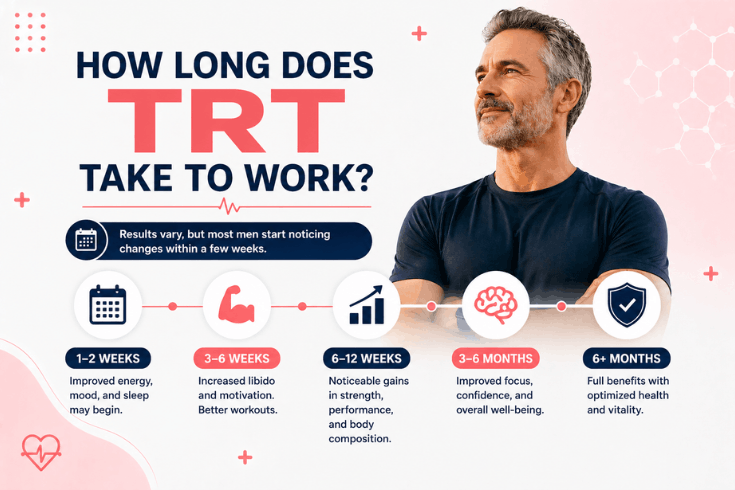
Testosterone replacement therapy typically starts producing noticeable changes within 3 to 6 weeks, with full results taking 6 to 12 months depending on the symptom. Different benefits follow completely different schedules libido improves in weeks, muscle mass takes months, and bone density continues changing for years. How quickly you feel results also depends on which delivery method you use and several factors specific to your physiology.
You are in the right place if you recently started TRT and want to know what to expect and when, or if you are several weeks in and wondering whether your treatment is actually working. This guide covers the complete timeline from week one through month twelve, how delivery methods change that timeline, what slows results down, and what to do when your progress doesn’t match expectations.
When to Expect Each TRT Benefit: A Symptom-by-Symptom Timeline
The most important thing to understand about Testosterone replacement therapy (TRT) timelines is that your body doesn’t change all at once. Some effects are driven by testosterone acting directly on receptor sites — those changes happen within weeks. Others require changes at the cellular and tissue level — those take months.
The table below is sourced from a 2011 systematic review of testosterone clinical trials published in the European Journal of Endocrinology, which analyzed the time course of TRT effects across controlled studies.
| Symptom / Benefit | When Changes Begin | When Full Effect Reached |
|---|---|---|
| Libido and sexual interest | 3–4 weeks | 6 weeks (plateaus — no further increase expected) |
| Mood and depressive symptoms | 3–6 weeks | 18–30 weeks |
| Morning and spontaneous erections | 3 weeks | Up to 6 months |
| Energy and stamina | 4–6 weeks | 3–6 months |
| Muscle strength | 12–20 weeks | 6–12 months |
| Body fat reduction | 12–16 weeks | 6–12 months |
| Insulin sensitivity | Days to 2 weeks | 3–12 months for full glucose control |
| Bone mineral density | 6 months | Continues for at least 3 years |
| Red blood cell count | 3 months | 9–12 months |
Libido and sexual interest
tend to be the first clear signal that TRT is working. Most men report a noticeable change within 3 to 4 weeks, with the effect plateauing around the 6-week mark. This plateau is normal it does not mean libido will decline from that point, but the rapid early improvement levels off.
Mood changes
arrive slightly later, typically within 3 to 6 weeks, but full stabilization takes considerably longer. The 18-to-30-week range for maximum mood effects means men who report “feeling better but not back to normal” at month two are still mid-timeline, not stalled.
Muscle strength and body composition
are the changes men most commonly get impatient about, and they are also the slowest. Measurable strength changes begin at 12 to 20 weeks. Body fat reduction becomes observable around weeks 12 to 16. Both require consistency with resistance training — testosterone amplifies the response to exercise, but does not replace it.
Bone mineral density
is a benefit most men don’t think about but doctors measure during long-term TRT. It won’t show up in how you feel, but it begins changing at 6 months and continues for years, which is part of why TRT is considered a long-term commitment rather than a short course.
Does Your TRT Delivery Method Change How Fast It Works?
The delivery method you use fundamentally changes how quickly testosterone enters your bloodstream, how consistently it stays there, and therefore how early you might feel effects.
| Delivery Method | How It Enters Bloodstream | Onset of Noticeable Effects | Reaches Stable Levels | Key Trade-off |
|---|---|---|---|---|
| Injections (cypionate/enanthate) | Direct into muscle; peaks within 24–48 hours | 2–3 weeks | Cyclical — peaks shortly after injection, troughs before next dose | Fastest onset; dosing every 7–14 days creates hormone swings |
| Testosterone gel | Absorbed through skin daily | 4–6 weeks | ~3 months of consistent daily use | Steady delivery; absorption varies significantly between individuals |
| Subcutaneous pellets | Implanted under skin; steady release | 2–6 weeks (serum rises within 48 hours; stabilizes over ~63 days) | ~2 months post-insertion | Longest-acting; no daily maintenance |
| Transdermal patches | Skin absorption, same mechanism as gel | 4–6 weeks | Similar to gel | Skin irritation is common |
Injections
reach therapeutic blood levels the fastest because testosterone is delivered directly into muscle tissue. The trade-off is that serum testosterone peaks 24 to 48 hours after injection and then declines toward the lower end before the next dose. Men on weekly injections sometimes notice their energy and mood shift over the course of the week — higher mid-week, lower toward day 6 or 7. This is a delivery issue, not a dose problem.
Gels and patches
deliver testosterone at a slow, continuous rate that more closely mimics natural production. The benefit is hormonal stability — no peaks and troughs. The limitation is that serum levels take about three months to fully stabilize, and absorption through the skin varies substantially between individuals. Two men on the same gel dose can have measurably different serum testosterone levels.
Pellets
offer the most “hands-off” delivery — one insertion procedure lasts several months. Serum testosterone rises within 48 hours of insertion and stabilizes over roughly 63 days. They produce steady blood levels but cannot be adjusted mid-cycle if dose turns out to be too high or low.
5 Factors That Affect How Quickly Testosterone Therapy Starts Working
The timelines above describe typical ranges. Why some men land at the early end and others at the late end comes down to these five factors.
1. Starting testosterone level
Men with severely deficient baseline levels — below 200 ng/dL — often experience the most dramatic early changes because the physiological gap being closed is larger. Men who start TRT with levels in the low-normal range may notice subtler early changes.
2. SHBG (sex hormone-binding globulin) levels
SHBG is a protein that binds testosterone in the blood, making it unavailable to tissues. A man can have a total testosterone reading that looks acceptable but still have most of it bound to SHBG, leaving very little free testosterone to act on muscle, brain, and libido. If results aren’t coming and your doctor only checks total testosterone, ask for free testosterone and SHBG alongside it.
3. Estrogen conversion
Testosterone converts to estradiol through a process called aromatization, primarily in fat tissue. This conversion is normal and necessary — some estradiol is essential for bone health and libido in men. But when conversion runs high, often in men with higher body fat, estradiol rises to levels that actively suppress the benefits TRT is meant to deliver. A man with significant excess body fat may feel little to nothing on TRT not because the dose is wrong, but because a large fraction of his testosterone is becoming estrogen before it can act.
4. Delivery method and individual absorption
Beyond the method-level differences already covered, individual physiology affects absorption rates within the same method. Skin thickness, hydration levels, and application site all influence how much of a gel or patch dose actually enters circulation. Two men on identical gel prescriptions can test with total testosterone levels 200 ng/dL apart.
5. Lifestyle factors
Sleep quality, alcohol intake, body fat percentage, and stress levels all affect how testosterone functions once it is in the bloodstream. Chronic sleep deprivation suppresses the endogenous hormonal signals that TRT works alongside. High alcohol consumption increases aromatization, worsening the estrogen conversion problem. Stress-driven elevations in cortisol directly antagonize testosterone’s actions at the receptor level.
TRT Isn’t Working: What to Do at Each Stage
If your experience isn’t matching the timeline above, the answer depends entirely on where you are in treatment. Here is a stage-by-stage framework.
Weeks 1–4: Nothing yet this is normal: No adjustment is appropriate this early. Your body is still equilibrating to a new hormonal baseline. The exception: if you experience significant side effects (severe acne, chest tightness, signs of elevated hematocrit), contact your provider immediately.
Weeks 4–8: Libido and mood should be showing early movement: If neither has changed at all by week 8, something is worth investigating. The most common culprits at this stage are:
- Elevated estradiol (above 40–50 pg/mL) blocking testosterone’s effects at receptor sites
- Dose too low to bring total testosterone into range
Ask your provider to check total testosterone, free testosterone, and estradiol. Do not ask for a dose increase based on symptoms alone before these numbers are in hand.
Weeks 8–12: Energy should be improving: If fatigue persists despite confirmed testosterone levels in range, two conditions deserve investigation before attributing the problem to TRT response speed. Sleep apnea is significantly more common in men with low testosterone and produces fatigue that TRT alone will not resolve. Hypothyroidism produces a nearly identical symptom profile to low testosterone and will not respond to TRT at all.
Months 3–6: Body composition changes should be emerging: If muscle or fat changes are absent at this stage, resistance training frequency and intensity matter more than most men expect. TRT amplifies the body’s response to exercise — without a training stimulus, the body composition effects remain minimal. If you are training consistently and still seeing no change, absorption and free testosterone levels warrant reassessment.
Month 6 and beyond: Comprehensive reassessment: The Endocrine Society’s clinical guidelines on testosterone therapy note that if adequate testosterone levels have been achieved and maintained for 3 to 6 months without symptom improvement, providers should consider whether hypogonadism is actually the cause of the presenting symptoms. Other conditions depression, sleep disorders, metabolic syndrome — produce symptoms nearly identical to testosterone deficiency, and TRT will not resolve them.
This is not a failure of TRT. It is the diagnostic process working correctly.
Frequently Asked Questions About How Long TRT Takes to Work
How do you know when TRT is working?
The clearest early signals are improved libido (3–4 weeks), better mood (3–6 weeks), and improved sleep quality (sometimes as early as week 1–2). Objective confirmation comes from follow-up bloodwork showing total and free testosterone in the therapeutic range, typically checked at 6–8 weeks after starting or adjusting a dose.
How long does it take for testosterone injections specifically to work?
Injections deliver testosterone directly into muscle tissue, where it reaches peak serum levels within 24 to 48 hours. Most men on injectable TRT notice early changes — especially libido and mood — within 2 to 3 weeks, which is faster than gel or patch methods. Full effects still take 6 to 12 months.
Why is my TRT not working after several weeks?
The most common reasons are: elevated estradiol from testosterone-to-estrogen conversion, insufficient dose not bringing free testosterone into range, poor gel or patch absorption, or an undiagnosed condition (sleep apnea, hypothyroidism) that TRT cannot address. Get a full hormone panel — total testosterone, free testosterone, estradiol, SHBG — before assuming TRT doesn’t work for you.
What are the first signs that testosterone therapy is working?
For most men, the first noticeable changes are better sleep quality, improved morning erections, and a return of sexual interest — typically within the first 3 to 6 weeks. Increased energy and motivation usually follow at weeks 4 to 8. Visible body composition changes are the last to arrive and require consistent training.
Does it matter which TRT delivery method I use for how fast it works?
Yes. Injections produce the fastest onset (2–3 weeks) because testosterone goes directly into muscle. Gels and patches take longer to build to consistent blood levels (4–6 weeks for initial effects; ~3 months for full stabilization). Pellets sit between the two — initial rise within days, full stabilization over about two months. The method that works fastest is not always the best choice — consistency of blood levels matters as much as speed.
How long do you have to stay on TRT?
TRT does not cure low testosterone — it replaces it. Stopping TRT returns testosterone to its prior baseline. Most men who begin TRT stay on it indefinitely. Some men opt for fertility-preserving alternatives if having children is a near-term goal, as TRT suppresses sperm production. The length-of-treatment conversation belongs with your prescribing physician.
Can TRT stop working over time?
Testosterone levels can drift if dosing isn’t adjusted as the body changes. Some men notice reduced effectiveness after years if their hematocrit climbs (reducing red blood cell oxygen efficiency) or if aromatization increases with body weight gain. These are adjustable variables — TRT “stopping working” usually means something in the protocol needs recalibration, not that the therapy itself has a shelf life.
What happens if TRT doesn’t work after 3–6 months?
Clinical guidelines recommend a formal reassessment. If testosterone levels are confirmed in range and symptoms haven’t improved after 3–6 months, the presenting symptoms may not have a primary hormonal cause. Conditions including depression, sleep disorders, and metabolic syndrome produce a nearly identical symptom picture to testosterone deficiency and require different treatment approaches.
If your symptoms aren’t improving on your current TRT protocol, the next step isn’t waiting longer. Ask your prescribing provider to run a full hormone panel — total testosterone, free testosterone, and estradiol — at your next visit. Bring the symptom timeline from this guide to the appointment so you can point to exactly which milestones you have hit and which you haven’t. That specificity gives your provider what they need to make a meaningful protocol adjustment rather than defaulting to “give it more time.”