
Cost & Access
Fountain TRT Review: Cost, Injections, Enclomiphene, and Is It Legit?
Fountain TRT costs $199/month for an all-inclusive TRT plan. Injections, enclomiphene, insurance reality, weight loss, and honest downsides.
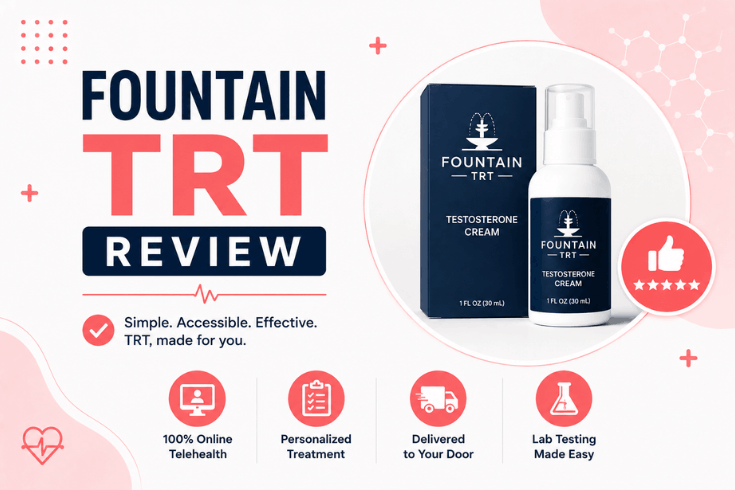
Fountain TRT is one of the most visible online testosterone replacement therapy clinics in the U.S., and for good reason. The $199/month all-inclusive model cuts through the insurance maze most men hit when trying to get TRT through their primary care doctor. But the ads do not answer the questions men are actually asking before signing up: Do they offer real injections, or just cream? What is this enclomiphene option? Does TRT actually help with weight loss? Do they take insurance? And critically: is this company legitimate? This review answers all of that. Not from a press kit. From research across Trustpilot reviews, clinical data, Fountain’s own treatment documentation, and the actual complaints men raise before and after starting treatment.
Fountain TRT is a telehealth clinic that provides testosterone replacement therapy for men with clinically low testosterone. It operates entirely online: you complete a health assessment, get bloodwork at a partner lab or at home, consult with a board certified urologist via video, and receive your prescription medication shipped directly to your door. Treatment options include topical testosterone cream, self-administered injections, and enclomiphene, an oral medication that stimulates the body’s own testosterone production rather than supplying it externally. This review covers every question that matters before you commit to a membership.
What Is Fountain TRT and How Does It Work?
Fountain TRT runs a four-step process designed to get you from “I think I have low T” to prescription-in-hand without ever entering a clinic.
Step 1: Complete the Low T assessment: You fill out a detailed health questionnaire online covering your symptoms, medical history, medications, and goals. This takes roughly 10 to 15 minutes.
Step 2: Get your bloodwork: Fountain partners with local labs across the U.S. for blood testing. If you cannot easily reach a lab, they have partnered with Getlabs for at-home blood draws (an additional ~$55). Your results are reviewed within the Fountain platform.
Step 3: Meet with a specialist: If your labs suggest testosterone deficiency, you are scheduled for a video consultation with a board-certified urologist. Fountain was co-founded by Dr. Doron Stember, MD, trained at NYU, Mount Sinai, and Memorial Sloan-Kettering, with over ten years of clinical experience in male testosterone deficiency. Your prescribing doctor reviews your labs, symptoms, and history before recommending a treatment approach.
Step 4: Receive treatment: Your prescription is filled and shipped directly. Ongoing follow-up consultations happen every 3 to 6 months, and you have unlimited messaging access to support staff between appointments. Fountain currently operates in 20 states: Alabama, Arizona, California, Colorado, Connecticut, Florida, Georgia, Illinois, Indiana, Michigan, New Jersey, New York, North Carolina, Ohio, Pennsylvania, Tennessee, Texas, Virginia, Washington, and Wisconsin.
How Much Does Fountain TRT Cost?
Fountain TRT costs $199 per month. That price is genuinely all-inclusive: it covers your medication, shipping, initial consultation, follow-up provider visits, ongoing lab interpretation, and unlimited support messaging. There are no separate pharmacy co-pays and no hidden consultation fees. The one variable cost is the at-home blood draw. If you use Getlabs instead of driving to a partner lab, expect to add approximately $55 per draw. Follow-up labs are required every 3 to 6 months. Some men are prescribed adjunct medications alongside testosterone, including Anastrozole (an aromatase inhibitor to manage estrogen), HCG (to maintain testicular function), or tadalafil (generic Cialis). These may carry additional costs depending on your plan. The enclomiphene program pricing is separate and should be confirmed directly with Fountain at the time of consultation.
| Item | Cost |
|---|---|
| Monthly membership (medication + consult + labs + support) | $199/month |
| At-home blood draw via Getlabs (optional) | ~$55 |
| Initial Low T assessment | $280 (often discounted to ~$90) |
| Adjunct medications (Anastrozole, HCG, tadalafil) | Varies |
| Enclomiphene program | Confirm at consultation |
For comparison, traditional in-person TRT through a urology clinic often costs $300 to $600 per month when you factor in consultation fees, lab costs, and pharmacy costs separately, even with insurance. Fountain’s flat-fee model removes that unpredictability.
Does Fountain TRT Take Insurance?
Fountain TRT does not bill health insurance directly. The membership is a flat self-pay model. However, Fountain does accept HSA (Health Savings Account) and FSA (Flexible Spending Account) cards. If you are already contributing pre-tax dollars to an HSA or FSA through your employer, you can apply that money to your Fountain membership, which effectively reduces your cost by your marginal tax rate.
Some patients submit Fountain’s itemized receipts to their insurance carrier for potential out-of-network reimbursement. Whether that succeeds depends entirely on your specific plan and insurer. Fountain does not facilitate this process. Why the self-pay model? Traditional insurance coverage for TRT is notoriously difficult. Insurers frequently deny initial authorizations, require prior lab thresholds that do not match clinical reality, and limit which testosterone formulations they will cover. Fountain’s flat-fee approach eliminates prior authorizations, coverage denials, and formulary restrictions entirely. You pay a fixed monthly amount and receive treatment. If insurance coverage is a dealbreaker, Fountain is not the right choice. If you have an HSA or FSA and want predictable monthly costs with no bureaucratic friction, the model works well.
Does Fountain TRT Offer Injections?
Yes. Fountain TRT offers self-administered testosterone injections alongside their topical cream option. The standard injection is testosterone cypionate, a long-acting ester administered either subcutaneously (a shallow injection under the skin, similar to insulin) or intramuscularly, depending on your doctor’s recommendation. Injections are typically dosed every 1 to 2 weeks at home. Your provider walks you through the technique during your consultation and follow-up visits. Fountain’s marketing has historically emphasized the cream because many men are needle-averse. But injections are a standard and legitimate request during your consultation. Some men prefer them because:
- Blood levels may be more consistent and predictable with injections than with cream absorption
- Injections allow more precise dosing adjustments
- Subcutaneous injections are minimally invasive. The needle is short and thin, and most men report minimal discomfort
Here is how the delivery methods compare:
| Testosterone Cream | Testosterone Injection | |
|---|---|---|
| Administration | Applied to shoulder daily | Self-injected every 1 to 2 weeks |
| Needle required | No | Yes (subcutaneous or IM) |
| Blood level consistency | Variable (absorption varies by individual) | More predictable |
| Convenience | Daily routine | Bi-weekly or weekly |
| Transfer risk | Yes (skin-to-skin contact) | None |
| Dosing flexibility | Moderate | High |
If you are unsure which method fits your situation, that discussion happens during your Fountain consultation. Both are available.
Fountain TRT Enclomiphene: What It Is and Who Should Consider It
Enclomiphene is not testosterone replacement. It is a different class of treatment that produces a similar outcome through a different mechanism. Understanding the distinction matters before you decide which Fountain program is right for you. Traditional TRT supplies testosterone externally, which raises your blood testosterone levels but suppresses your body’s own production. Over time, this causes the testes to reduce natural testosterone and sperm output, which is why fertility concerns and testicular atrophy are associated with long-term TRT use.
Enclomiphene works the opposite way. It is a selective estrogen receptor modulator (SERM) that blocks estrogen receptors in the hypothalamus. When the hypothalamus detects less estrogen signal, it increases production of LH (luteinizing hormone) and FSH (follicle-stimulating hormone). Those hormones travel to the testes and stimulate them to produce more testosterone naturally, meaning your levels rise without shutting down your own production.
Who enclomiphene is right for:
- Men with low testosterone who want to preserve or protect fertility
- Men who want to avoid testicular atrophy
- Men who are not candidates for traditional TRT due to medical history or preference
- Men who want to optimize testosterone without committing to external hormone replacement
Fountain offers enclomiphene as both a standalone monotherapy program and as an adjunct to standard TRT (where it supports testicular function while TRT manages overall levels). Dosing typically ranges from 6.25 mg to 25 mg per day, customized after initial bloodwork.
| Standard TRT | Enclomiphene | |
|---|---|---|
| Mechanism | External testosterone supplied | Stimulates natural production |
| Effect on fertility | Suppresses sperm production | Preserves or improves sperm count |
| Testicular atrophy risk | Yes | Minimal |
| Delivery method | Cream or injection | Oral (daily pill) |
| Results timeline | 3 to 6 weeks | 4 to 6 weeks |
| Best for | Men not concerned with fertility | Men who want natural hormone optimization |
Most men on the enclomiphene program report improvement in energy, libido, mental clarity, and physical performance within 4 to 6 weeks of starting. Timing varies based on baseline hormone levels and individual response.
Does Fountain TRT Help With Weight Loss?
Testosterone therapy is not a weight loss drug, but it has a well-documented effect on body composition, and that distinction matters for setting realistic expectations. Low testosterone is directly associated with increased visceral fat, the abdominal fat stored around organs, which is metabolically active and linked to insulin resistance, cardiovascular risk, and metabolic syndrome. When testosterone levels are restored to a healthy physiological range, several things happen: the body becomes more efficient at building and maintaining lean muscle mass, resting metabolic rate increases as a result, and visceral fat tends to decrease over time, particularly with the addition of resistance training and a reasonable nutrition approach.
This is not rapid weight loss. It is gradual body composition change that compounds over months. Fountain TRT members have reported meaningful results. One member documented dropping from 217 lbs to 190 lbs over several months of TRT alongside a training program. According to Fountain’s member data, patients see an average energy level increase of 40% within the first 3 months, which typically translates into more consistent activity and better adherence to exercise.
For men who need more aggressive support with fat loss, Fountain also offers GLP-1 and semaglutide weight loss add-ons alongside the TRT plan. These are a separate program from the base membership and require a separate consultation and prescription. Semaglutide works by reducing appetite and slowing gastric emptying, and it is a validated weight loss intervention when prescribed appropriately. If weight loss is your primary goal and testosterone optimization is secondary, discuss both tracks with your Fountain provider at consultation. The two are complementary but distinct.
Is Fountain TRT Legit? An Honest Look at Credentials and Complaints
Fountain TRT is a legitimate, physician-operated telehealth clinic. But “legitimate” is not the same as “right for everyone,” and understanding both the company’s strengths and its documented shortcomings will tell you more than any marketing page.
The case for legitimacy:
Fountain was co-founded by Dr. Doron Stember, a board-certified urologist with training at NYU, Mount Sinai, and Memorial Sloan-Kettering, one of the premier cancer treatment centers in the world. His clinical subspecialty is male testosterone deficiency. That is not a general practitioner advising on hormones. That is a specialist in the exact condition being treated.
On Trustpilot, Fountain holds a 4.4 to 4.9 star rating across hundreds of reviews. The majority of positive reviewers cite genuine improvements: increased energy, libido restoration, better sleep, fat loss, and mood stabilization.
According to Fountain’s own member data, patients see an average testosterone increase of 213% from baseline.
The legitimate complaints:
Not all reviews are positive, and the critical ones carry patterns worth noting:
- Pricing vs. compounding pharmacy alternatives: Some reviewers note that the same testosterone cypionate available through a compounding pharmacy directly costs a fraction of $199/month. The Fountain premium covers the telehealth infrastructure, specialist oversight, and convenience, not the medication cost itself.
- Cancellation difficulty: Multiple reviewers report that canceling the membership was harder than expected, with continued billing after cancellation attempts. This is a real concern with subscription-model telehealth services generally.
- Blanket dosing: A minority of reviewers felt their dosing was not sufficiently individualized, that the protocol felt generic rather than calibrated to their specific labs and symptom response.
- Delivery delays: Occasional reports of shipping delays, though most reviewers describe delivery as reliable.
Fountain TRT is not a scam. The pricing model is transparent, the physicians are real, and the treatment produces real results for most members. The caveats around subscription management, cost relative to DIY options, and variable individualization are worth knowing before you commit.
Fountain TRT Pros and Cons
| Pros | Cons |
|---|---|
| $199/month all-inclusive, no hidden costs | Does not bill traditional health insurance |
| Board-certified urologist co-founder with deep specialization | Cancellation reported as difficult by some users |
| Multiple treatment options: cream, injections, enclomiphene | At-home blood draw costs ~$55 extra |
| Preserves fertility via enclomiphene program | Available in only 20 states |
| HSA/FSA accepted | Pricing higher than compounding pharmacy DIY alternatives |
| Unlimited support messaging between appointments | Some reports of blanket dosing rather than highly individualized protocols |
| At-home blood draw available via Getlabs | GLP-1 weight loss add-ons are separate from base membership |
| Strong Trustpilot track record (4.4 to 4.9 stars) |
Frequently Asked Questions About Fountain TRT
Is Fountain TRT legit?
Fountain TRT is a legitimate physician-led telehealth clinic. Its co-founder is a board-certified urologist with specialty training in testosterone deficiency. The company holds a 4.4 to 4.9 star rating on Trustpilot with hundreds of verified reviews. Legitimate complaints exist, primarily around the cancellation process and pricing versus compounding pharmacies, but there is no credible evidence of fraudulent practice.
How much does Fountain TRT cost per month?
The standard membership is $199 per month. This covers medication, shipping, your initial and follow-up consultations, lab interpretation, and unlimited messaging support. Optional add-ons include an at-home blood draw (~$55 via Getlabs) and adjunct medications like Anastrozole or tadalafil, which may carry separate costs.
Does Fountain TRT take insurance?
Fountain TRT does not bill traditional health insurance. The membership is self-pay. However, Fountain does accept HSA and FSA cards, and some patients submit itemized receipts to their insurer for potential out-of-network reimbursement. Success depends on your specific plan.
Does Fountain TRT offer injections or only cream?
Both. Fountain offers testosterone cream applied to the shoulder daily and testosterone cypionate injections administered at home every 1 to 2 weeks. Injections are self-administered subcutaneously or intramuscularly after a provider walkthrough. Cream is Fountain’s default recommendation, but injections are a standard option available through your consultation.
What is enclomiphene and why does Fountain offer it?
Enclomiphene is a selective estrogen receptor modulator (SERM) that stimulates the brain’s own hormonal signals to increase natural testosterone production, without suppressing fertility or causing testicular atrophy. Fountain offers it as a standalone program for men who want testosterone optimization without traditional TRT, and as an add-on to standard TRT to preserve testicular function. It is taken daily as an oral pill.
Can Fountain TRT help with weight loss?
Restoring testosterone to a healthy range can support fat loss, particularly visceral abdominal fat, by improving muscle mass, increasing metabolic rate, and boosting energy levels that support consistent exercise. It is not a rapid weight loss treatment. For men seeking more aggressive fat loss support, Fountain offers GLP-1 and semaglutide add-ons as a separate program alongside TRT.
What states does Fountain TRT serve?
As of 2026, Fountain TRT is available in: Alabama, Arizona, California, Colorado, Connecticut, Florida, Georgia, Illinois, Indiana, Michigan, New Jersey, New York, North Carolina, Ohio, Pennsylvania, Tennessee, Texas, Virginia, Washington, and Wisconsin.
How long before Fountain TRT starts working?
Most men report noticing initial improvements in energy, mood, and libido within 3 to 6 weeks of starting treatment. Full body composition changes, including muscle gain and fat reduction, typically become measurable at 3 to 6 months with consistent treatment and an active lifestyle. Enclomiphene follows a similar timeline, with most men seeing initial improvements within 4 to 6 weeks.
If your bloodwork confirms low testosterone, Fountain TRT’s $199/month membership gives you a specialist-reviewed prescription, ongoing lab monitoring, and treatment shipped to your door, without fighting your insurance. Start with the free Low T assessment at fountaintrt.com to see if you qualify.